|
|
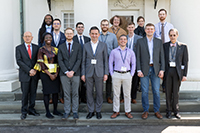
M.A. Program in Economic Theory and Policy Now Accepting International Students
|
We are pleased to announce that both our M.A. and M.S. programs are now accepting international students for fall 2020.
Designed as preparation for a professional career in economic research and policy formulation, the Levy Economics Institute Graduate Programs in Economic Theory and Policy offer an alternative to mainstream programs in economics and finance.
Our diverse student body comes from Afghanistan, Australia, Austria, Canada, Chile, Colombia, Ethiopia, Gambia, Germany, India, Kyrgyzstan, Lebanon, Nepal, Peru, the United Kingdom, and the United States, with research interests focusing on banking regulations, monetary policy in Europe, trade, financial regulations, economic forecasting, poverty, unemployment and exclusion, modern monetary theory, and stock-flow-consistent modeling. To find out more about our innovative programs that combine a rigorous course of study with exceptional opportunity to participate in advanced economics research alongside the Institute's global network of researchers, visit bard.edu/levygrad or follow the program's Facebook page.
Applications for fall 2020 are now open. Interested students should contact the program recruiter, Martha Tepepa ([email protected]), to discuss their options. Scholarships are available. |
Because "a viral epidemic, unfortunately, does not just sicken families; it also sickens the economy, and ours is quite vulnerable already," an interest rate cut may not be enough to spur investment and growth as the US formulates its response to COVID-19. In her first of two recent op-eds for MarketWatch, Research Scholar Pavlina R. Tcherneva calls instead for an "aggressive public-health-services mobilization and an economic stabilization package. And that's the job of Congress, not the Fed."
In the second, Tcherneva calls for a wartime-like mobilization of resources to ensure the coronavirus pandemic does not lead to a decades of elevated unemployment, suggesting that “only big government, big public investments, and big public-employment programs will ensure a quick bounce back, rather than another protracted jobless recovery,” a sentiment she echoes in two recent interviews. Hear more on the Bloomberg Surveillance and the Wharton Business Review podcasts.
Estimating that private demand could be weak for 18 months or more, Research Associate Stephanie Kelton tells Mehdi Hasan of the Intercept’s “Deconstructed” podcast that we must “decrease the amount that people are required to pay out each month and increase what’s coming in because that’s the only way people are going to be able to hold it together.” And in her March 21 op-ed for the New York Times, she explains that “only the federal government, has the means to step up and save the economy,” suggesting it “can and should use this opportunity to make ambitious, lasting improvements.”
|
|
|
|
|
|
|
|
You are receiving this e-mail because you either signed up at the Levy Institute website or filled out a request card asking to be placed on this list. If you have trouble accessing the Levy Institute's website, please send a brief description of the problem to [email protected].
Copyright © 1986-2020, Levy Economics Institute, Annandale-on-Hudson, NY 12504-5000. All rights reserved.
No responsibility is assumed by the publisher for any injury and/or damage to persons or property as a matter of products liability, negligence, or otherwise, or from any use or operation of any methods, products, instructions, or ideas contained in the material herein.
|
|
|