Research Programs
Gender Equality and the Economy
While gender inequalities have diminished in some aspects of life, they remain deeply rooted in others. The vast majority of women around the world do not enjoy equality in economic participation, physical security, access to land, and financial resources or earnings. Closing gender gaps requires policy interventions that enhance women's economic opportunities and outcomes.
The Levy Institute’s Gender Equality and the Economy (GEE) program focuses on the ways in which economic processes and policies affect gender equality, and examines the influence of gender inequalities on economic outcomes. GEE’s goal is to stimulate reexamination of key economic concepts, models, and indicators—with a particular view to reformulating policy. It offers a broad view of what an economy is and how it functions, bringing into the analysis not only paid work, but also unpaid work (unpaid family work, work devoted to subsistence activities, caring for household members, and community volunteer work), as an integral and key component of all economies. Ultimately, the program seeks to contribute knowledge and recommend policies that promote gender equality.
Our Research
GEE research concentrates on two primary themes: the gender dimensions of macroeconomic issues and international economic policy; and gender equality, poverty, and well-being in national and international perspective. In the past decade, a growing body of work has explored how macroeconomic outcomes are affected by gender inequalities, and how gender inequalities are influenced by macroeconomic policies. Although gender equality is not the focus of macroeconomic policy, such policies cannot be assumed to be gender neutral. Does a requirement to balance budgets make it more difficult to reduce gender inequality? Given the inability of markets to guarantee a job for all who seek one, how can public policy that promotes full employment be inclusive of gender equality considerations? How can economic growth and gender equality be made compatible? Can gender equality improve the employment/inflation trade-off?
The Levy Institute Measure of Economic Well-Being (LIMEW) was established in order to improve existing official measures of economic well-being and to allow for accurate cross-sectional and intertemporal comparisons. GEE has enhanced this area of the Levy Institute’s work by developing research on the intersection of gender inequality, expanded income, and time poverty. This research—including the reexamination of UN indicators for measuring gender inequality, new analyses of time-use data, and work preparatory to formulating alternative policy indicators—was central to the development of the Levy Institute Measure of Time and Income Poverty, a new, innovative income measure that accounts for the negative impact time deficits exert on living standards.
The Levy Institute Measure of Economic Well-Being (LIMEW) was established in order to improve existing official measures of economic well-being and to allow for accurate cross-sectional and intertemporal comparisons. GEE has enhanced this area of the Levy Institute’s work by developing research on the intersection of gender inequality, expanded income, and time poverty. This research—including the reexamination of UN indicators for measuring gender inequality, new analyses of time-use data, and work preparatory to formulating alternative policy indicators—was central to the development of the Levy Institute Measure of Time and Income Poverty, a new, innovative income measure that accounts for the negative impact time deficits exert on living standards.
GEM-IWG
The International Working Group on Gender, Macroeconomics, and International Economics (GEM-IWG) is a global network of economists formed for the purpose of promoting gender equity in the context of the world economy. GEE has partnered with GEM-IWG in organizing a series of seminars and conferences that are designed to promote a more focused international dialogue on the social dimension of globalization, and to explore the relationship between gender inequality and the economic liberalization policies that underpin the globalization process. The series is ongoing:
- Levy Institute–GEM-IWG Seminar and Conference on Gender, Macroeconomics, and International Economics, Krakow, Poland, July 2012
- Levy Institute–GEM-IWG Conference on Gender and the Global Economic Crisis, New York City, July 2009
- Levy Institute–GEM-IWG Seminar on Gender and the Global Economic Crisis, Annandale-on-Hudson, N.Y., Summer 2009
Network
Associated Program
The Levy Institute Measure of Time and Income Poverty
Program Publications
-
Press Releases | March 2024
Estimates Show about 80 Percent of Services Enhancing Household Consumption Are Provided by Women
Download:Associated Program(s):Author(s):Mark Primoff
-
Research Project Reports | March 2024
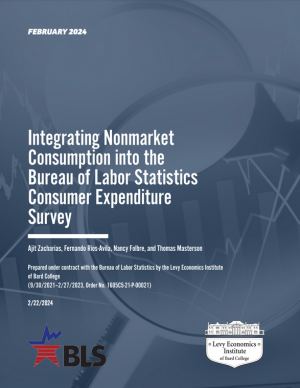 In spring 2021, under the direction and encouragement of Commissioner William Beach, the US Bureau of Labor Statistics (BLS) kicked off a major initiative—to produce a measure of consumption to supplement the release of consumer expenditures. The production of such a measure would fill a data gap regarding household economic well-being. For years BLS staff, with support from the public, had discussed the possibility of producing a consumption measure. However, it was the experience of COVID-19 and the role of home production for consumption that nudged the Bureau to promote the development of such a measure. To support this new initiative, the BLS sought input from the greater research community and public: first through the organization of a Consumption Symposium; and second through a Request for Information (RFI) that would result in an outside BLS contract. Consumption Symposium speakers included well-known national and international researchers who are expert in various aspects of measurement, including home production; the Symposium was held September 21–22, 2021. In parallel, the RFI was issued in May 2021 with responses received in July 2021. This was followed by Request for Quotation (RFQ) in September 2021. The Levy Institute was awarded the contract with a period of performance of twelve months beginning September 30, 2021.
The following report includes the Levy Institute’s findings in developing an empirical methodology and identifying data sources (including the BLS American Time Use Survey) to extend the consumer expenditure data collected by the BLS (using Consumer Expenditure Surveys) by incorporating household production (nonmarket and nongovernmental services such as do-it-yourself home repairs and childcare). The researchers—Ajit Zacharias, Fernando Rios-Avila, Nancy Folbre, and Thomas Masterson—found that an overwhelming share of home production is provided by women. Distinct from most previous research, this research extends the scope of household production to include supervisory childcare and care received by household members from people outside their household. Estimates are generated for various major components of household production, such as childcare and cooking, rather than a single category. Included are estimates by alternative methods with monetary values of household production. This research represents an extension of the work the Levy Institute has been doing in bringing the realm of household production into economic analysis, including the creation of alternative measures of economic well-being (LIMEW) and poverty (LIMTIP).
During fiscal year 2024, the BLS will be evaluating the methodology proposed in this report with an expectation that a BLS consumption measure that includes home production will be forthcoming in 2025.
The full report can be downloaded here.
Tables and figures from the report can be downloaded here.
Additional detailed information on the quality checks conducted regarding the imputations from the ATUS data can be found here.
The GitHub repository files contain detailed information on the three methods of imputation, weekday and weekend imputations, and results pertaining to each CE file (Interview, Diary, quarter, etc.). These files contain information that we used to check the quality of imputations. Users who want to use a particular method (say statistical matching) and a particular file (say third-quarter Interview sample) can check the quality of imputation for their use with the help of the information available in the repository. In assessing the quality, the users could use the strategy we provide in the report or their own criteria.Associated Program(s):Author(s): -
Working Paper No. 1045 | March 2024This inquiry examines the role of federal policy in gender inequality using the principles of institutional adjustment (Foster 1981; Bush 1987) in the context of the Veblenian dichotomy of habit formation. Specifically, the authors assert that Social Security, though exclusive at its inception in 1935, has undergone significant institutional adjustment. Today, Social Security plays a determining role in providing the appropriate institutional space for not only increasing economic security for older women, but also for reducing gender inequality overall.Download:Associated Program(s):Author(s):Liudmila Malyshava B. Oak McCoyRelated Topic(s):Economic stability Economics of gender Gender disparities Gender equality Gender inequality Gender studies Social SecurityRegion(s):United States
-
Working Paper No. 1041 | February 2024
Can Green Spending Reduce Gender and Race Inequalities?
Announced in June 2021, the never-implemented Green Recovery Plan for the Brazilian Legal Amazon Region (GRP) would be a green transition initiative to be carried out by the state governments of the region. The GRP represented the first large-scale proposal aiming at the transition to a low-carbon economy in Brazil and offered a preliminary framework to evaluate the opportunities and limitations of green development in Global South economies. The GRP's initial phase would provide an investment of 1.5 billion reais (around $315 million in September 2023) in four areas: control of illegal deforestation, sustainable development, green technology, and green infrastructure. This article presents a counterfactual analysis by assessing the impacts of green spending in Amazon on the labor market, quantitatively—in terms of the number of jobs created—and qualitatively—exploring the distribution of those jobs by region and according to gender and race categories. We build synthetic sectors representing each area of investment in a two-region input-output matrix (“Brazilian Amazon” and “Rest of Brazil”). Using employment multipliers, we simulate a demand shock on the Amazonian economy and its impact on job creation in the two regions. Results suggest that green spending in the Amazon offers good perspectives (but also highlights limitations) for a just transition to a low-carbon economy in Brazil: the effects on employment favored the female workforce (both black and white) relative to the male and black workforce in the Amazon, leading to inequality-reducing composition changes in the Brazilian workforce as whole.Download:Associated Program(s):Author(s):Related Topic(s):Region(s):Latin America -
Press Releases | December 2023Download:Associated Program:Author(s):Mark Primoff
-
Working Paper No. 1027 | August 2023Structural change has long been at the core of economic development debates. However, the gender implications of structural change are still largely unexplored. This paper helps to fill this gap by analyzing the role of structural change in the gender distribution of sectoral employment in sub-Saharan African countries. I employ aggregate and disaggregate measures of gender sectoral segregation in employment on a panel database consisting of 10 sectors and 11 countries during 1960–2010. Fixed effects and instrumental variables’ regression models show a significant, non-linear link between labor productivity and gender segregation. Increasing labor productivity depresses gender segregation at initial phases of structural change. However, further productivity gains beyond a certain threshold of sectoral development increases gender segregation. Country-industry panel data models complement the analysis by considering relative labor productivity as a determinant of sectoral feminization. The estimates suggest that manufacturing, utilities, construction, business, and government services are key to correcting gender biases in employment along the process of structural change.Download:Associated Program:Author(s):Izaskun ZuazuRelated Topic(s):
-
Press Releases | May 2023Download:Associated Program(s):Author(s):Mark Primoff
-
Working Paper No. 1016 | February 2023Monetary policy has been historically concerned with controlling inflation, using the interest rate as its main tool. However, such policies are not gender- or race-neutral. This paper explores econometrically the effect of changes in the interest rate for female and black employment creation in Brazil. We conduct a panel data fixed effects analysis for 13 states between 2012 and 2021 to estimate the effects of changes in interest rates on unemployment, separating the data by gender and race. Our results show that the real interest rate has a positive effect on the relative unemployment of black men to white men, no effect on the relative unemployment of black women to white men, and a negative effect on the relative unemployment of white women to white men. These effects are intensified in regions where the black population ratio is lower. This paper contributes to understanding the challenges to closing gender and racial gaps, particularly in developing economies. We conclude that social stratification, if not considered, can lead to misleading policies that perpetuate unequal socioeconomic outcomes.Download:Associated Program:Author(s):Patricia Couto Clara BrenckRelated Topic(s):
-
Working Paper No. 1009 | August 2022
Empirical Evidence from Subnational Governments in India
Public financial management (PFM) has a significant role in linking resources to results by financing human development outcomes. When economic stimulus packages are short run in nature, thematic PFM, such as child budgeting, has a crucial role in reducing crime against children. Using fixed effects models, we explore the determinants of reduced crime against children. The PFM-related variables are found to have greater impact than economic growth per se in tackling crime against children. Capital expenditure in the social sector is found to be inversely related to crimes against children, though mere allocation in social sector budgets is not found to be effective in reducing crime rates. Specific PFM tools, like child budgeting, need to be analyzed for their role in child protection services. In India, child budgeting has been introduced in states where the rates of crime against children are also high. To understand the efficacy of child budgeting in reducing crime rates, the year of inception (year in which the child budgeting was introduced in the state) of children budgeting in a state is incorporated in the panel models. The coefficients reveal that years of inception and crime against children are inversely related, reinforcing the effectiveness of PFM tools such as child budgeting in reducing crimes. The existence of a positive link between social expenditure and the incidence of crime is at first counterintuitive, but a closer examination reveals a nonlinear relationship between crime incidence and social spending, which is revealed from the statistically significant negative squared term. -
Research Project Reports | June 2022
Time Use, Employment, and Poverty
There is broad consensus in both research and policy circles that one of the key reasons for a lack of progress in reducing gender gaps in employment and wages is the persistent gender imbalance in unpaid work, three-quarters of which is performed by women. Universal access to quality care services enables the reduction of this unpaid care work through its redistribution from the domestic sphere to the public sphere, with empirical studies from different regions and countries demonstrating that access to services (in particular, childcare services) substantially increases female labor force participation and labor market attachment. Furthermore, a series of recent empirical studies show that access to care also creates new demand for female employment: increasing public spending on care is found to generate two-to-three times the number of new jobs per dollar than spending on sectors such as construction.
This research project report focuses on Mexico and builds on previous studies for Turkey, Ghana, and Tanzania by constructing a combined time-use and income-employment dataset for Mexico to evaluate the net effects a proposed childcare expansion could have on earnings and work hours and their concomitant impact on time and income poverty by gender, with results indicating that the employment creation achieved through increased social care spending reduces gender employment gaps while also helping to alleviate the twin deprivations of time and income poverty.Download:Associated Program(s):The Distribution of Income and Wealth Gender Equality and the Economy The Levy Institute Measure of Time and Income PovertyAuthor(s):
Program Scholars
Research Programs