
Sound Accounting and Uncompromising Vision: Remembering Wynne Godley at 100
by Gennaro Zezza, and Marc Lavoie
September 2026 marks the centenary of the birth of Wynne Godley, one of the most original and consequential macroeconomists of the late twentieth century.
For the Levy Economics Institute of Bard College, this anniversary holds a deeply personal significance. It was here, in the final and exceptionally fruitful chapter of his long career, that Godley—alongside Hyman Minsky and a devoted cohort of colleagues—cemented a paradigm shift in heterodox macroeconomics.
Godley brought to economics an unusual discipline, shaped in part by his early training as a professional oboist at the Paris Conservatoire. He understood harmony, structure, and the rigorous dynamic relationship between individual parts and the whole. When he turned his mind to macroeconomics—first at HM Treasury, then as Director of the Department of Applied Economics (DAE) at the University of Cambridge, and finally as a Distinguished Scholar at the Levy Institute—he applied that same demand for internal coherence.
Where mainstream macroeconomic modeling relied on representative agents and equilibrium abstractions that ignored financial balances, Godley insisted on a fundamental truth: everything must add up. Every monetary flow must come from somewhere and go somewhere, and every financial asset must be matched by a corresponding liability.
When Godley affiliated with the Levy Institute in 1994, building on his previous empirical work within the Cambridge Economic Policy Group, he set out to build a macroeconomic framework that could map structural imbalances and provide early warnings of financial crises.
His work centered on the famous “Three-Sector Financial Balances” identity:
Private Balance + Public Balance + Foreign Balance = 0
Through the Levy Institute Macro-Modeling Team, Godley sounded early alarms. Throughout the late 1990s and mid-2000s, as conventional wisdom celebrated the “Great Moderation,” Godley’s Strategic Analysis reports demonstrated that the boom in the United States was driven by unprecedented, unsustainable levels of private sector indebtedness.
His “Seven Unsustainable Processes,”[1] published in 1999, provided a timely prediction of the 2001 recession, at a time when other economists were celebrating the dot-com boom.
He famously warned that an economy relying on private debt expansion to offset fiscal tightening and structural trade deficits would inevitably face a severe balance-sheet recession.
When the 2007–2008 Global Financial Crisis unfolded exactly along the fault lines he had identified,[2] Godley’s method ceased to be seen as merely an alternative approach; it was vindicated as a necessary tool for macroeconomic survival.[3]
At the same time, Wynne Godley was pursuing his efforts to fully integrate the real and the financial sides of macroeconomic theory, which he had started to do in his first book, co-authored with Francis Cripps in the early 1980s. Godley’s magnum opus, Monetary Economics: An Integrated Approach to Credit, Money, Income, Production and Wealth (co-authored with Marc Lavoie in 2007), provided the definitive theoretical foundation for Stock-Flow Consistent (SFC) modeling, based on sequential processes of real and financial interactions. As Godley used to say, “there cannot be any black holes.” The book remains a foundational text taught in heterodox graduate programs worldwide.
The adoption of Godley’s framework in peer-reviewed literature reflects a stark structural break surrounding the 2007 financial crisis, which overlaps with the publication of his major book with Marc Lavoie.
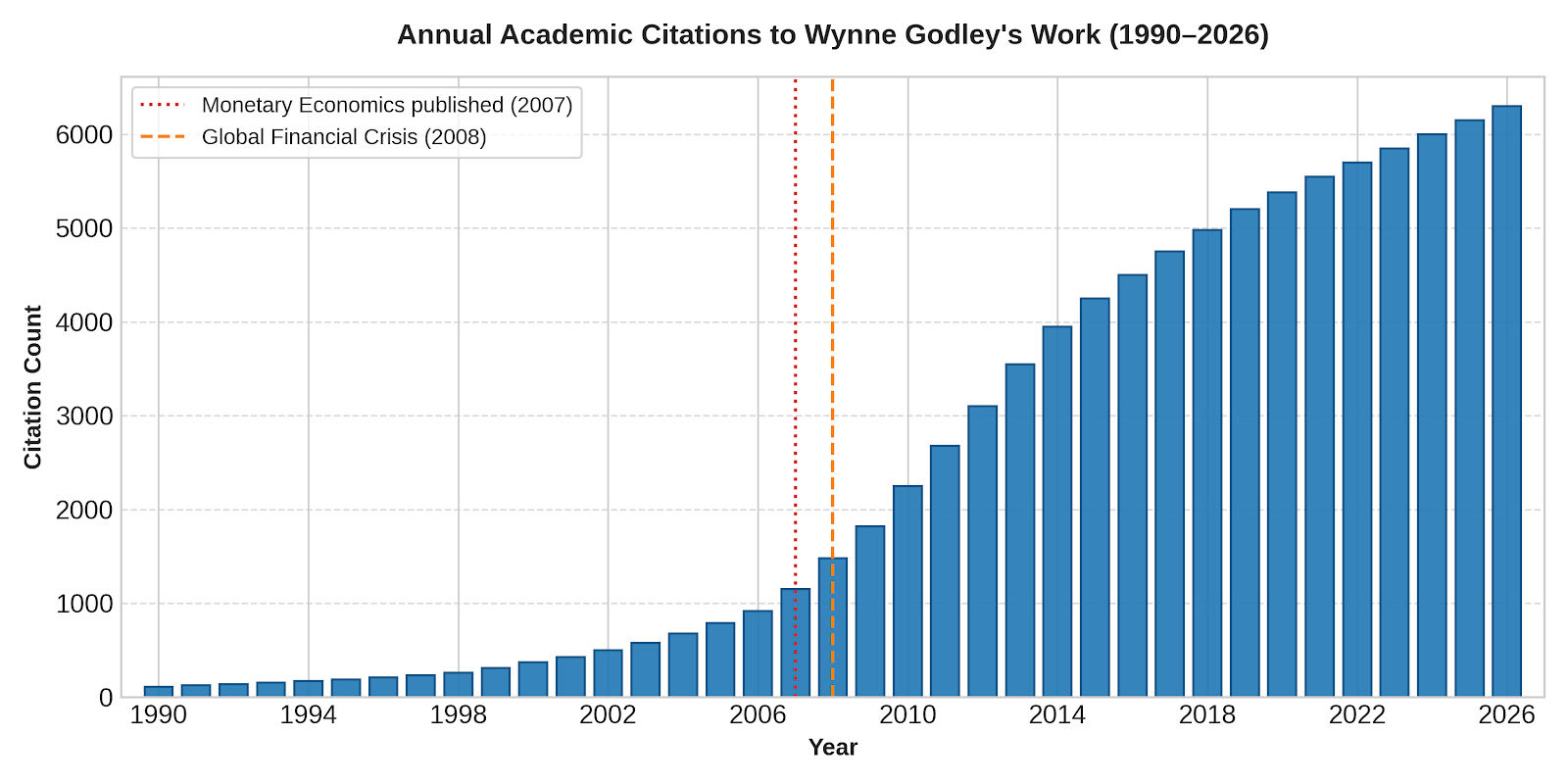
Source: Aggregated bibliographic data from Google Scholar, RePEc (Research Papers in Economics), and OpenAlex (1990–2026). Counts track annual academic citations to Wynne Godley’s core works, including Macroeconomics (Godley & Cripps 1983), Levy Institute Strategic Analysis reports, and Monetary Economics (Godley & Lavoie 2007). Cumulative citations.
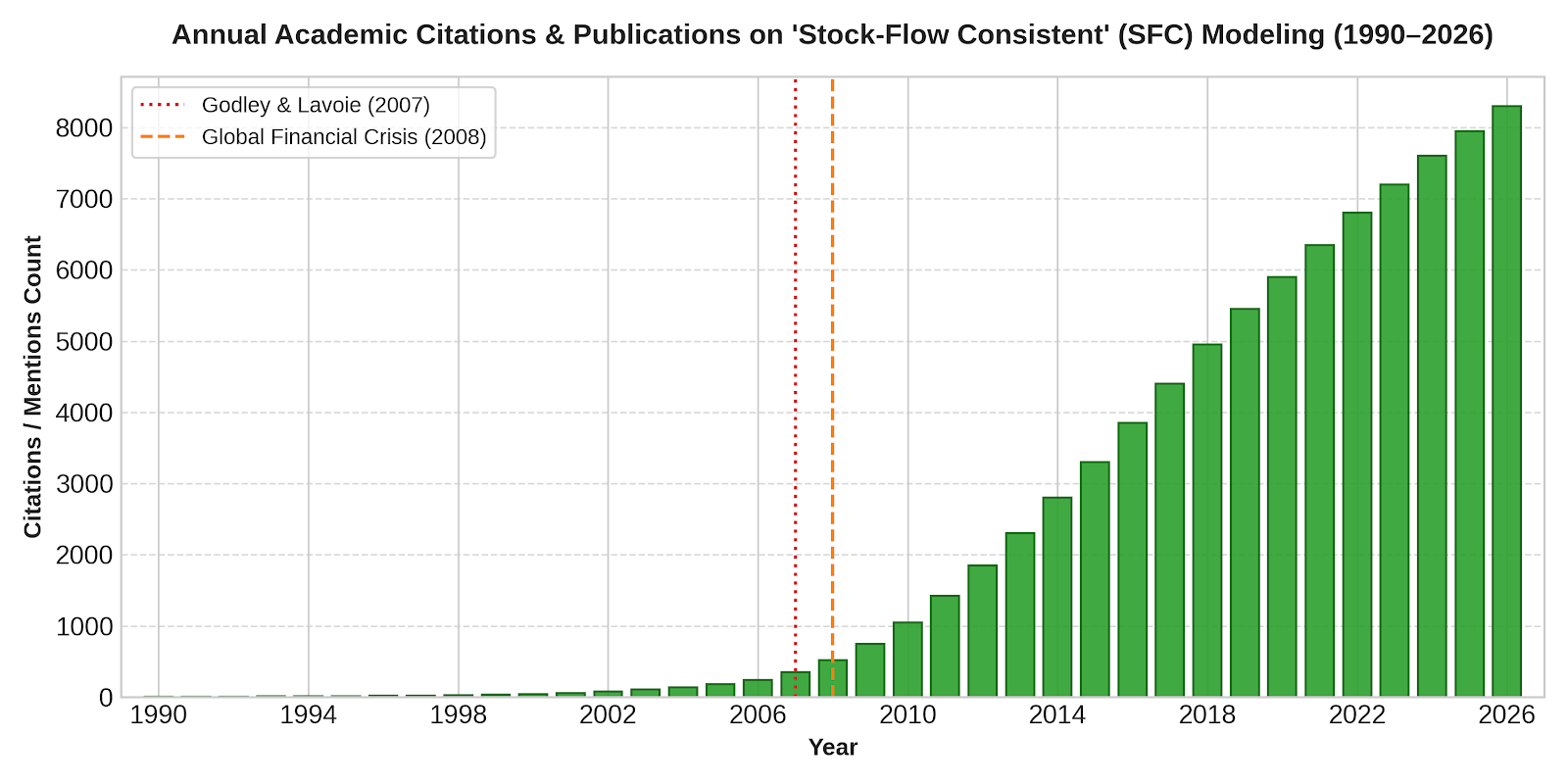
Source: Multi-database bibliometric query (Scopus, Web of Science, and Google Scholar) for publications referencing “stock-flow consistent” / “SFC modeling”. Framework adapted from Rosales et al. (2026) and Nikiforos & Zezza (2017). Cumulative citations.
A century after his birth, Wynne Godley’s theoretical legacy is more vibrant than ever. Today, the Stock-Flow Consistent methodology he pioneered at Levy is deployed to model some of the most urgent macroeconomic challenges of our time: climate risk and ecological transition, income inequality, international currency hierarchies, financial instability, and sovereign debt vulnerabilities.
An annual Godley-Tobin memorial lecture is organized every year by the Review of Keynesian Economics, and the international conference on empirical Stock-Flow Consistent models will have its fourth annual meeting in Paris in November 2026.
Having worked with Godley for a long period of time, we truly miss his insights to guide us in these turbulent times!
Marc Lavoie
University of Ottawa, and Université Sorbonne Paris Nord
Gennaro Zezza
University of Cassino, and Levy Economics Institute
Notes
[1] Godley (1999)
[2] See Godley – Zezza (2006) among others.
[3] See Lavoie – Zezza (2012) for a selection of Godley’s contributions.
References
W. Godley (1999) Seven Unsustainable Processes, Levy Economics Institute, Strategic Analysis, January.
W. Godley & F. Cripps (1983) Macroeconomics, Fontana.
W. Godley & M. Lavoie (2007) Monetary economics: An Integrated Approach to Credit, Money, Income, Production and Wealth, Palgrave Macmillan London
W. Godley & G. Zezza (2006) Debt and Lending: a Cri de Cour, Levy Economics Institute, Policy Note n.4, April.
M. Lavoie & G. Zezza (eds.) (2012) The Stock-Flow Consistent Approach: Selected Writings of Wynne Godley, Palgrave Macmillan London
M. Nikiforos & G. Zezza (2017) “Stock-flow consistent macroeconomic models: A survey”, Journal of Economic Surveys, 31: 1204-1239.
F. O. Rosales, G.Y. Llerena, G.T. Yajima, & F. Martín-Mayoral (2026). “The Evolution and Diversification of Stock-Flow Consistent Modelling: A Bibliometric Review” Levy Economics Institute Working Paper No. 1126, July.