
Breaking the Tragedy of the Horizon? Characterizing the Green Turn of Monetary Regimes
This event has ended.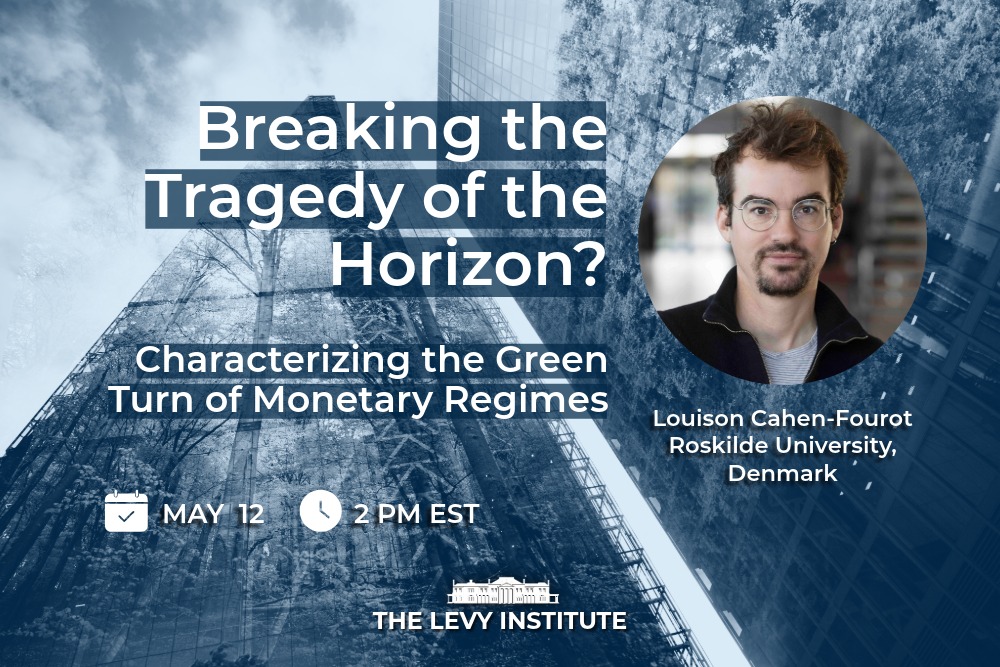
When
May 12, 2026 - 2:00pm - 3:00pmWhere
Levy Conference RoomAlthough remaining controversial and in its infancy, the “greening” of monetary policy and financial regulation is spreading. Such an environmental turn appears as a key channel to reform capitalism, through redirecting finance towards so-called “green” capital. This environmental turn may mean more than merely a set of technical adjustments to central banks operations and risk management by financial institutions. In recent history, significant changes in the forms taken by money, in the modalities of its issuance, of its circulation and in the basis of its valuation heralded, and responded to, equally substantial mutations in the broader political economy. In post-World War II capitalism, changes in monetary regimes turned out to be early signs of structural changes in the patterns of growth and capital accumulation. We take stock of the green turn in monetary regimes throughout the world, keeping in mind that such changes do not occur in an institutional vacuum and instead co-evolve with the other institutional forms governing the society. We assemble a comprehensive database of policies integrating environmental criteria into monetary policy and financial regulation to date and characterize the main varieties of green monetary regimes. We identify three broad types of green monetary regimes. Yet, many countries do not fall into any of the green monetary regime types: the institutionalization of ecological issues in monetary policy and financial regulation appears as a diverse and, to some extent, idiosyncratic, vulnerable and contested process. Based on these results, we discuss consequences for the consistency of capital accumulation regimes.
Louison Cahen-Fourot is an associate professor of Economics at Roskilde University in Denmark, and a visiting scholar at Harvard’s Minda de Gunzburg Center for European Studies for the spring of 2026. His research explores the interdependencies between economic, financial, and ecological dynamics that shape long-term transformations of contemporary capitalism, in the fields of ecological macroeconomics and the political economy of social-ecological transformation. Among other topics, Cahen-Fourot has written on the climate-finance nexus, green monetary policy and central banking, the economic and financial conditions and impacts of the low-carbon transition, the social relation to the environment in the diversity of capitalism, the relation between socio-metabolic regimes and accumulation regimes, and post-growth economics. Before moving to Denmark, he was a postdoctoral researcher for four years at WU Vienna University of Economics and Business’s Institute for Ecological Economics in Austria. He holds a PhD in Economics from Sorbonne Paris-Nord University, master’s degrees in international economics from Sorbonne Paris-Nord and in sustainable development from Clermont-Auvergne University, and a bachelor in economic and social administration from the University of Bordeaux.