
Money Managers and the Rise of Financial Fragility, Private Market Version
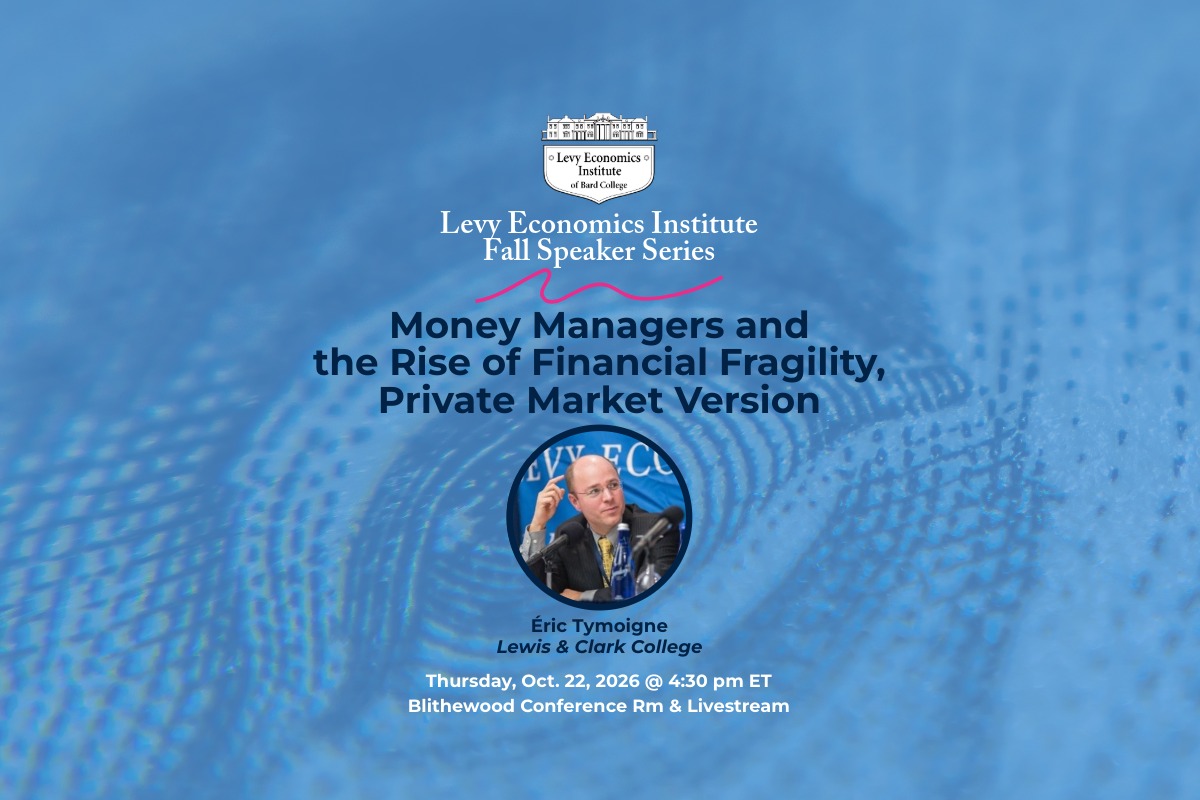
When
October 22, 2026 - 4:30pm - 5:30pmWhere
Livestream - register to join& on campus at Blithewood Conference Rm.
Private debt and equity markets have been a funding source for nascent and credit constrained businesses for several decades. Following the 2008 financial crisis, an economic environment characterized by low interest rates, cautious banks, and tighter financial regulations—together with money managers on the hunt for higher yielding assets—provided a fertile ground for the rapid growth of the private debt market. The defaults of two major borrowers in 2025, the growing concerns about the sustainability of AI businesses, and the ongoing wave of redemption requests, have all led to worries that private markets may be a source of financial instability. The current dominant view has brushed these worries aside by arguing that the private debt market is small, that private debt deals have a lot of equity buffer (leverage is low), that covenants attached to private debt allow for the quick correction of problems in a way that promotes the long-term success of businesses, and that low default rates reflect the inherent soundness of private markets. In his Levy Speaker Series talk, Éric Tymoigne aims to challenge such a narrative. Private markets are major contributors to the growth and spread of financial fragility. The financial practices that preceded the Great Recession are once again becoming more common: loose underwriting and credit rating; the growing use of interest refinancing; the growing use of opaque asset-pricing methods; the rise of financial engineering that hides leverage, embeds leverage, and generates ephemeral liquidity; and a policy environment that promotes deregulation, desupervision, and deenforcement. Together with the growing interdependence between private debt markets, private equity markets, banks, and money managers, these dangerous financial practices generate a financial environment in which fraud can grow quickly and financial instability can materialize.
The Levy fall speaker series aims to explore the forces shaping our economic lives—from capitalism to financial stability to the policies that hold (or fail to hold) our economy together. Each session features a guest economist, policymaker, author, or researcher whose work sheds light on issues such as financial fragility, structural forces impacting economic resilience, and the public policies foundational to economic democracy. Drawing on the Institute’s long tradition of heterodox and policy-relevant research, the series offers a forum for lively discussion and debate about how our economic system can be made more stable, equitable, and aligned with the public good in democratic societies. Talks are free and open to all Bard College students, faculty, and staff, with time reserved for audience questions.
Éric Tymoigne is an associate professor of economics at Lewis & Clark College who specializes in the fields of money and banking, monetary theory, and financial macroeconomics. He formerly taught at California State University, Fresno. His current research agenda includes the nature, history, and theory of money; the detection of aggregate financial fragility and its implications for central banking; the coordination of fiscal and monetary policies; and the theoretical analysis of monetary production economies.
He has published in numerous academic journals and edited volumes. His most recent book, coauthored with L. Randall Wray, is The Rise and Fall of Money Manager Capitalism: Minsky’s Half Century from World War Two to the Great Recession.
Tymoigne holds an MA in economic theory and policy from the Université Paris–Dauphine and a Ph.D. in economics from the University of Missouri–Kansas City.