
The AI Bubble: From Boom to Financial Bust
This event has ended.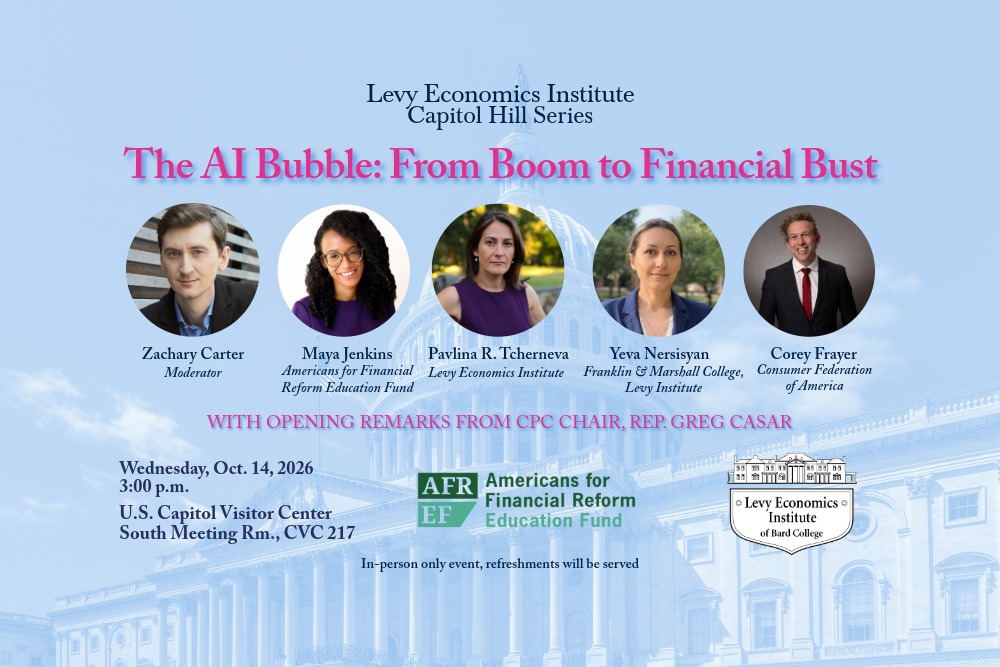
When
October 14, 2026 - 3:00pm - 5:00pmWhere
Capitol Visitor CenterSouth Congressional Meeting Room (CVC 217)
20515
This event has passed, but presentations from our panelists are available: Corey Frayer, (Director of Investor Protection for the Consumer Federation of America), Maya Jenkins (Americans for Financial Reform Education Fund) and Yeva Nersisyan (Franklin & Marshall College, Levy Institute).
In the next installment of its Capitol Hill Series, the Levy Economics Institute of Bard College is partnering with Americans for Financial Reform Education Fund to convene a discussion in Washington, DC addressing a question increasingly on the minds of investors and regulators: is the extraordinary run-up in AI-related valuations sustainable, or is it the latest chapter in a familiar boom-bust pattern? In examining the financial plumbing behind the AI buildout, the forum aims to identify and illuminate potential sources of financial fragility—and what to do about them. This event is in-person only, the panel will feature Corey Frayer (Consumer Federation of America), Maya Jenkins (Americans for Financial Reform Education Fund), Yeva Nersisyan (Franklin & Marshall College, Levy Institute) and Pavlina Tcherneva (Levy Institute) and will be moderated by author Zach Carter.
With opening remarks from CPC Chair, Rep. Greg Casar.
Zachary Carter is the author of the New York Times bestseller The Price of Peace: Money, Democracy and the Life of John Maynard Keynes, winner of the Arthur Ross Book Award and the Hillman Book Prize. His work has been published in The Wall Street Journal, The Atlantic, The New Yorker, The New York Times and other outlets. He is currently on contract with Random House for a biography of John Stuart Mill.
Corey Frayer is the Director of Investor Protection for the Consumer Federation of America. Corey leads the CFA’s efforts protecting retail investors, their retirement accounts, and overseeing the regulation of America’s $125 trillion capital markets. Corey has nearly 20 years of experience in the House, Senate and at the Securities Exchange Commission advising on financial regulatory issues ranging across consumer protection, bank regulation and supervision, financial stability, fintech policy, and application of the securities laws to crypto assets. Prior to joining the CFA, Corey was Senior Adviser to SEC Chair Gary Gensler on both Crypto Markets and Financial Stability, where he also served as an SEC Deputy on the Financial Stability Oversight Council. Prior to that, Corey served 15 years in Congress for Representative Brad Miller, on the House Financial Services Committee for Representative Maxine Waters, and on the Senate Banking and Housing Committee for Senator Sherrod Brown.
Maya Jenkins is a Senior Policy Analyst at Americans for Financial Reform Education Fund (AFREF), where she develops strategies for reimagining and implementing rules for a financial system that serves the public interest. Before joining AFREF, Maya served as a Policy Analyst at the Federal Deposit Insurance Corporation (FDIC), where she helped develop and implement resolution frameworks for the nation’s largest banks. She previously served as a Legislative Aide in the Office of U.S. Senator Elizabeth Warren, where she covered banking and capital markets. She holds a B.A. from Harvard University. Her writing on the economy can be found in The Boston Globe and elsewhere.
Yeva Nersisyan is a Levy Research Scholar and an associate professor of economics at Franklin and Marshall College in Lancaster, PA. She received her B.A. in economics from Yerevan State University in Armenia, and her M.A. and Ph.D. in economics and mathematics from the University of Missouri-Kansas City. She is a macroeconomist working in the Modern Money Theory, Post-Keynesian, and Institutionalist traditions. Her research interests include banking and financial instability, and fiscal and monetary theory and policy. She has published a number of papers on the topics of shadow banking, fiscal policy, government deficits and debt, and the Green New Deal. Nersisyan is currently coediting the Elgar Companion to Modern Money Theory with L. Randall Wray.
Pavlina R. Tcherneva is the Levy Economics Institute President, a professor of economics at Bard College and the founding director of the Bard Economic Democracy Initiative. She specializes in monetary macroeconomics and public policy. Tcherneva’s book The Case for a Job Guarantee (Polity 2020) is a timely guide to the benefits of one of the most transformative public policies being discussed today, recognized by the Financial Times in 2020 and published in nine languages. Her early work assessed Argentina’s adoption of a similar largescale job creation proposal she had developed with colleagues in the United States. Tcherneva has collaborated with experts from the United Nations Human Rights Council, the International Labor Organization, members of the European Parliament, as well as policy makers from the United States and abroad on designing and evaluating employment programs. She also worked with the Sanders 2016 Presidential campaign after her research on inequality had garnered national attention. In 2020, she was invited to serve on the Biden-Harris economic policy volunteer committee, during their Presidential run. Her areas of research include monetary and fiscal policy coordination, the Bernanke doctrine, and policy responses during the 2008 and 2020 COVID-induced economic crises. She is the coeditor of Full Employment and Price Stability: The Macroeconomic Vision of William S. Vickrey (Edward Elgar 2004), a rare collection of writings on employment and inflation by the Nobel Prize–winning economist, adapted for the modern day. In 2006, she was a visiting scholar at the University of Cambridge, U.K., where she immersed herself in J.M. Keynes’s collected writings. She developed an interpretation of Keynes’s policy approach to full employment for which she was recognized by the Association for Social Economics with the Helen Potter Prize (2012).
If you are registered for this event, please see the U.S. Capitol Visitor Center website for information on travel and security procedures.
The event will be held in Congressional Meeting Room South (CVC 217) which is on the lower level of the Capitol Visitor Center.
Enter through the CVC main entrance at First & East Capitol streets.