
Levy Scholar Giuliano T. Yajima Awarded Joan Robinson Prize, Review of Political Economy
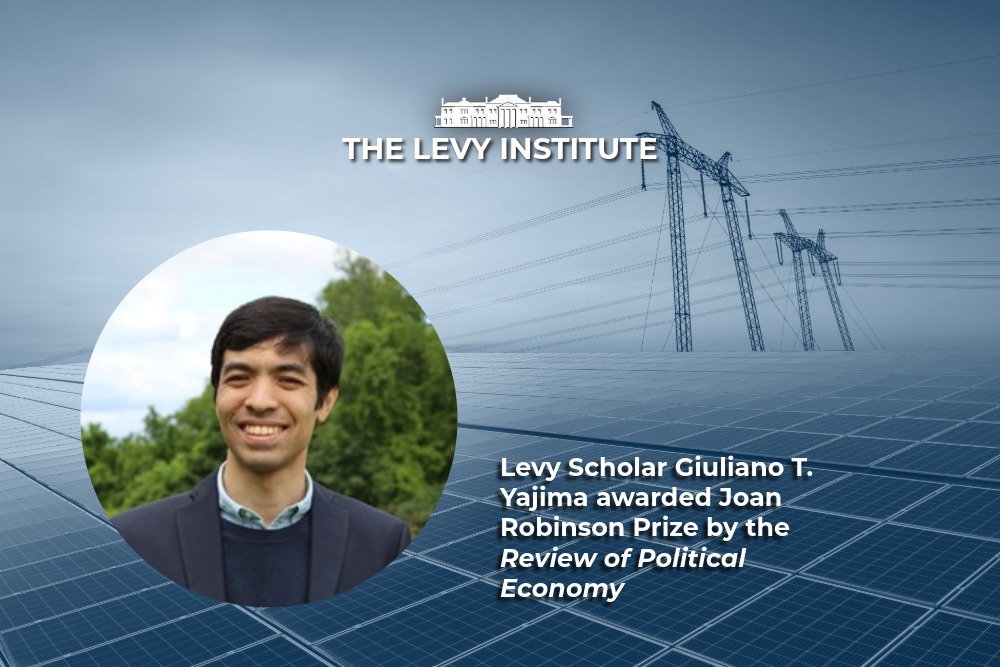
For his paper, “Beyond Job Guarantee: The Employer of Last Resort Program as a Tool to Promote the Energy Transition,” Levy Scholar Giuliano T. Yajima has been awarded the Joan Robinson Prize, an award that honors young scholars, given by the Review of Political Economy and sponsored by Taylor & Francis.
The Joan Robinson Prize, named in memory of Joan Violet Robinson, is awarded annually to the best paper published in the Review of Political Economy by a young scholar (PhD candidates and scholars up to five years after the completion of their PhD). The prize honors the legacy of Joan Robinson, a key figure in post-Keynesian and Cambridge economics. In the 1950s, Robinson contributed to its theoretical foundations, and in the early 1970s, she played a crucial role in its institutionalization (Rochon, 2023). Her seminal work, The Accumulation of Capital, remains a cornerstone in the field, addressing various topics such as production techniques, monetary issues, distribution, and growth – topics that continue to be relevant for post-Keynesian economists today. Her contributions to the ‘Cambridge controversy’ challenged neoclassical views on capital and distribution, revealing their theoretical inconsistencies.
Yajima’s statement: “I am deeply humbled that my original contribution to ROPE, “Beyond Job Guarantee: The Employer of Last Resort Program as a Tool to Promote the Energy Transition,” has been selected for the 2025 Joan Robinson Prize. I would like to thank the Editor-in-Chief, Louis-Philippe Rochon, the co-editors, Sylvio Antonio Kappes and Maria Cristina Barbieri Goes, as well as the two senior scholars from the journal’s Advisory Board for this recognition. The paper develops a multisectoral Stock-Flow Consistent model to study the long-run effects of different policy measures, including a Green Job Guarantee. Its main finding is that pursuing the dual objectives of full employment and environmental sustainability requires the government to invest in gross fixed capital formation while simultaneously reducing energy consumption and acting as an employer of last resort. I believe this research remains highly relevant in light of the ongoing debate surrounding energy costs, the transition toward a low-carbon economy, and the potential job losses associated with these structural changes. These themes are central to the research agenda we have been pursuing at the Levy Economics Institute of Bard College, where we continue to advance these questions drawing on the contributions of many prominent Post-Keynesian scholars.”
Read the Paper