
Smoothing the Stress Test: Averaging Reduces Capital Requirement Volatility, Not Fragility
On September 30, 2026, the Fed decided that, starting with the 2028 cycle, each large bank’s stress capital buffer will be set on the basis of the average of its two most recent supervisory stress tests rather than on the latest one alone. The stated goal is to reduce year-to-year volatility in capital requirements.
Averaging does reduce the volatility of capital requirements, but not necessarily financial fragility. This note argues that the main weakness lies in the stress test itself. First, it registers the flow of income that high interest rates bring to banks, but not the valuation losses they cause on the stock of assets. Second, its scenario rules out a recession in which rates stay high, because it implicitly treats inflation as demand-driven. Since projected capital declines have become shallower in recent tests, averaging would be slightly more demanding today—but only because the test itself understates the risks of high rates. Once those risks show up in the test, averaging will slow the system’s response: capital requirements will rise more slowly than the risk they are meant to cover.
How Capital Requirements Work
Bank capital requirements are expressed as a ratio. The numerator is common equity tier 1 (CET1) capital—essentially shareholders’ equity. The denominator is risk-weighted assets (RWA), in which each asset counts according to its regulatory riskiness: 0 percent for Treasury securities, 50 percent for most mortgages, 100 percent for most corporate loans. A large bank complies when

The minimum is fixed, and the surcharge applies only to the eight global systemically important banks. The stress capital buffer (SCB) is the only part that responds to the Fed’s assessment of risk. Each year the Fed projects banks’ balance sheets a little over two years ahead under a severe hypothetical recession: unemployment rises to at least 10 percent, house, commercial real estate, and equity prices fall, and interest rates fall. The resulting fall in the CET1 ratio sets the buffer:
SCB = max(projected maximum CET1 decline +four quarters of dividends; 2.5%)
The buffer therefore depends on what the test captures. The question is what it misses when interest rates are high.
What the Test Captures, and What It Misses
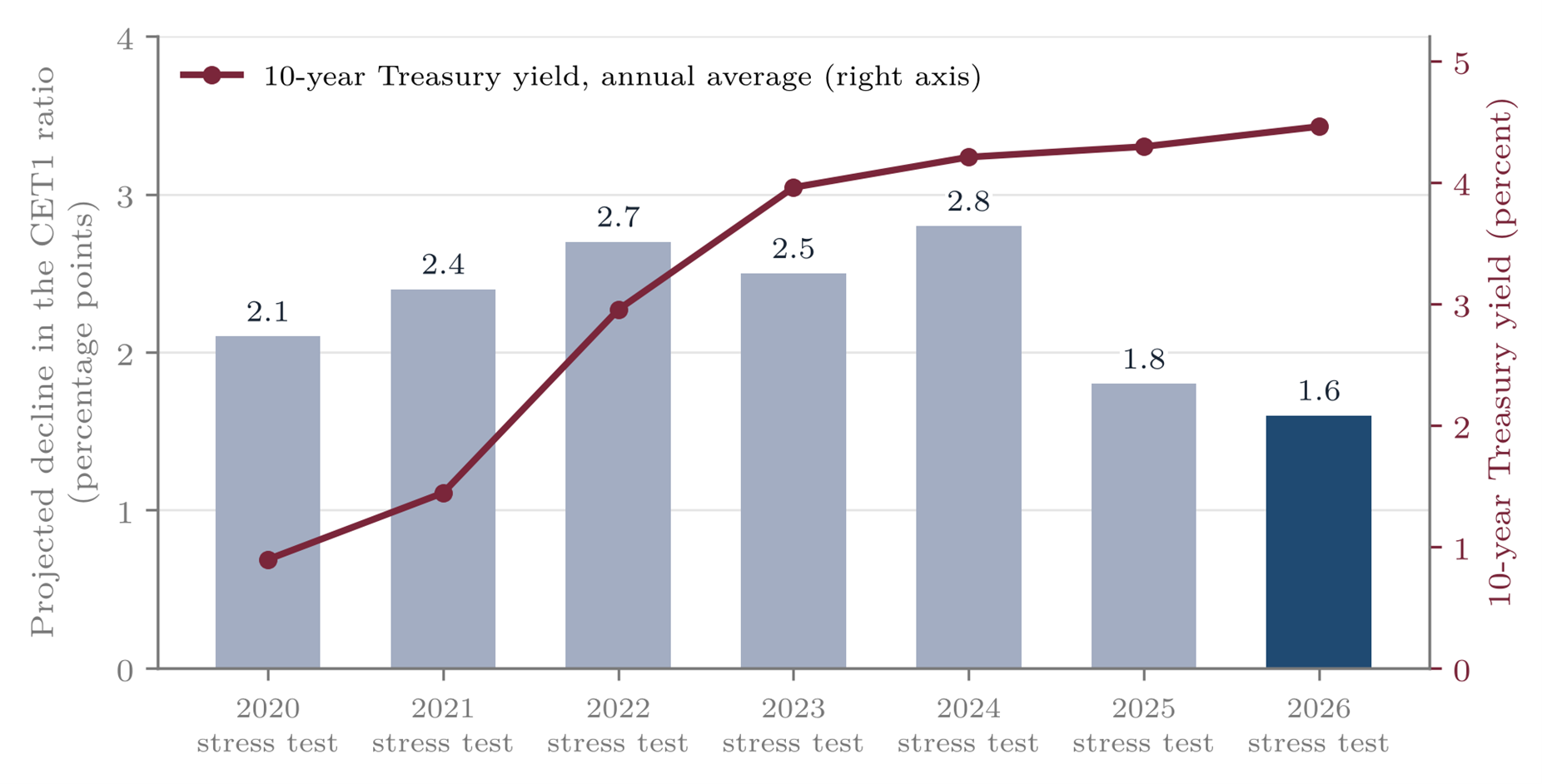
Projected capital declines have been shrinking—from 2.8 percentage points in the 2024 test to 1.6 in 2026, the smallest since the SCB was introduced in 2020 (Figure 1). The reason is not lower projected losses but higher projected revenues, in which the upward trend in long-term interest rates—reflected both in banks’ recent income and in the scenarios—played a key role. In a nutshell, high rates in the test make banks look stronger.
Figure 1: Projected Maximum Decline in the CET1 Ratio and 10-year Treasury Yield
Source: Federal Reserve (Board of Governors of the Federal Reserve System 2026)
Higher interest rates reduce the market value of fixed-rate assets, but these losses are not fully reflected in regulatory capital. The denominator does not directly capture them: risk weights are based on asset categories rather than changes in market value. The numerator captures them only partially: depending on accounting and regulatory rules, some valuation losses reduce capital only when assets are sold. As a result, substantial losses may remain invisible in regulatory capital ratios until banks are forced to realize them.
Finally, the test assumes that the Fed cuts interest rates when unemployment rises, because the Fed’s scenario model assumes that inflation is essentially a demand-pull, monetary phenomenon, and sets rates following a sort of Taylor-type rule. However, if a rise in unemployment is accompanied by cost-push inflation, this falls outside the framework. In that case, the Fed would misinterpret cost-push inflation as demand-pull inflation, and would keep rates high while unemployment rises. In this case, credit losses may grow, deposits could fall by seeking higher yields, and unrealized losses would sooner or later be realized. In other words, the stress test builds scenarios that do not contemplate the possibility of cost-push stagflation, with a Fed that may resist cutting interest rates. The test thus captures the benefit of high rates but not their cost. Reported CET1 overstates the capital banks have, and the SCB understates the capital they need.
Why Averaging Can Make It Worse
When stress test results fluctuate from year to year, averaging smooths capital requirements without systematically raising or lowering them. But when results follow a persistent trend, averaging is not neutral: it delays adjustments in either direction.
Today, projected capital declines are falling (Figure 1), so averaging would make capital requirements slightly more demanding than those implied by the latest test. In this sense, averaging partially offsets the consequences of a stress test that already understates fragility by capturing the income from high interest rates but not their full costs.
The problem arises when this trend reverses. If future stress tests begin to capture the risks associated with persistently high interest rates, particularly under a cost-push stagflation scenario, projected capital declines would increase. Yet averaging would delay the corresponding rise in capital requirements. In that case, it would compound an existing underestimation of banking fragility precisely when the risks previously overlooked by the test begin to emerge.
The central problem, therefore, remains the stress test itself. Averaging may temporarily mitigate its bias while projected capital declines are falling, but it would slow the correction once those declines begin to rise. It reduces the volatility of capital requirements without necessarily reducing financial fragility.
As Minsky argued, financial fragility is not random noise: it builds during long periods of stability, and stability itself breeds instability. Capital buffers should therefore rise as fragility builds, so they can be drawn down in a crisis. However, the stress test and the resulting SCB may operate procyclically with respect to financial fragility: they register the income that high interest rates bring but not their full costs, and rule out a recession in which rates remain high. As a result, capital requirements may fall precisely when underlying fragility is increasing. Averaging partially offsets this problem while projected capital declines are falling, but aggravates it once the trend reverses by delaying the increase in capital requirements. Averaging reduces the volatility of capital requirements, not necessarily financial fragility.
References
Board of Governors of the Federal Reserve System. 2026. 2026 Supervisory Stress Test Results. Federal Reserve. https://www.federalreserve.gov/publications/files/2026-dfast-results-20260624.pdf.