
Warsh: Caught Between a Rock and a Hard Place
For over two decades, markets have been trained to hang on every word out of the Fed chair’s mouth. That conditioning doesn’t switch off because a new chair decides he’d rather they did not. Whatever Warsh intends by abandoning forward guidance, markets will keep listening for guidance anyway, and given how much of what he communicated at his first press conference on July 29th is genuinely confusing, the volatility that follows shouldn’t be written off as noise.
It helps to remember how recent forward guidance actually is. For most of the Fed’s modern history, chairs said as little as possible. Volcker built his authority on near-total silence, delivering essentially one landmark statement in 1979 announcing a shift to targeting bank reserves. This was a strategy that history would go on to prove didn’t work the way he thought it would (Tymoigne 2023). Greenspan turned saying nothing intelligible into an art form but his Fedspeak produced remarkably little volatility. He got credit for the Great Moderation anyway, for developments that had far more to do with the world around him than with anything he was doing at the Fed. Forward guidance became a practice around 2011 after Bernanke began holding press conferences after each interest rate decision, although as a concept it was debated since at least the early 2000s when the possibility of monetary policy effectiveness near the zero-bound was debated (Eggertson and Woodford 2003).
Most commentators watching Warsh are worried about exactly the wrong thing. The fear is that his incoherence will destabilize markets, but neither Volcker’s silence nor Greenspan’s fog did that. What destabilized markets was the Fed’s attempt to control something it never could actually control: the quantity of bank reserves (Volcker), or being asleep at the wheel and missing the financial fragility that preceded the Great Financial Crisis (Greenspan). That is, Fed-induced instability came from aiming at a target its tools can’t hit or from failing to use the regulatory tools that could actually work.
Wednesday’s press conference gave plenty of incoherent signals regardless. Warsh doesn’t believe in surprising markets, but then reaches for the Lucas critique to explain why he won’t tell them anything. He says he’s firmly committed to a 2 percent target, but then uses Goodhart’s law to avoid answering which inflation measure he’s actually watching. He insists there’s no tradeoff between inflation and unemployment, and then describes bringing inflation down by making “hard decisions” when the data calls for it (which is raising unemployment by a different name). We have long maintained that the Fed should not use interest rates to fine-tune the economy, a sentiment that Warsh himself expressed at the press conference. Yet, he also talks about “tightening conditions” when the time comes, which is fine tuning but with longer time lags.
If this press conference is a harbinger of things to come, the honest move would be to skip future press conferences altogether and go back to the pre-Bernanke habit of saying nothing at all. But Warsh has rejected that possibility as well.
The real danger from Warsh is not his poor communication style, but the likelihood of increasing dissent on the committee and pressure to raise rates while the AI bubble is likely leading the economy into collapse.
At the press conference, Warsh appeared as an inflation hawk who doesn’t actually want to fight inflation. He’d much rather the market did it for him, pointing to the fact that nominal and real yields have already risen. That posture is politically convenient and he can say, correctly, that he isn’t the one raising the short rate, while counting on the bond market to bid up long-term yields and do the tightening he won’t do out loud.
What Trump actually wants is low and stable rates today and tomorrow. That means low yields across the curve and getting there would require the Fed to manage both ends of it at once, the way Japan did for decades. Though a superior way of doing that is to set a low target rate and stick to it. In the US, there is no path to such a policy, and certainly not one from where Warsh sits.
The real story underneath all the noncommittal answers is not Warsh’s new communication style but rather the return of a monetarist flavor: a renewed emphasis on quantity-oriented policy objectives and the conviction that monetary and fiscal operations should remain clearly separated. While there is no evidence that the new Fed Chair intends to revive a Friedman-style monetary targeting regime—or even a Volcker-style liquidity restriction—Warsh has repeatedly expressed his desire to reduce the size of the Federal Reserve’s balance sheet and restore it to a more conventional role, marking a clear departure from Bernanke’s approach.
It seems that in Warsh’s view, the Fed’s large-scale asset purchases since the Global Financial Crisis blurred the boundary between monetary and fiscal policy. Recall that Bernanke himself spoke of the “fiscal components of monetary policy” (Tcherneva 2011). Those were originally introduced as temporary emergency measures but later became a permanent feature of the monetary policy framework. The Fed’s interest-bearing liabilities, particularly remunerated bank reserves, are viewed as transfers from the consolidated public sector to the private financial sector. From this perspective, reducing the size of the balance sheet would function as a form of quasi-fiscal contraction. To Warsh, it would appear as a “normalization” of the monetary policy framework by restoring a clearer institutional separation between the Federal Reserve and the US Treasury. He believes that such a separation would reinforce the credibility of the central bank, strengthen confidence in its commitment to price stability, and help anchor inflation expectations. As Levy Institute research shows, the Fed and Treasury always coordinate for the purposes of managing interest rates and clearing government payments (Tymoigne 2016). Warsh’s objection seems to be that the Fed has purchased a wide range of assets, which he considers to be a fiscal function and not the role of the Fed.
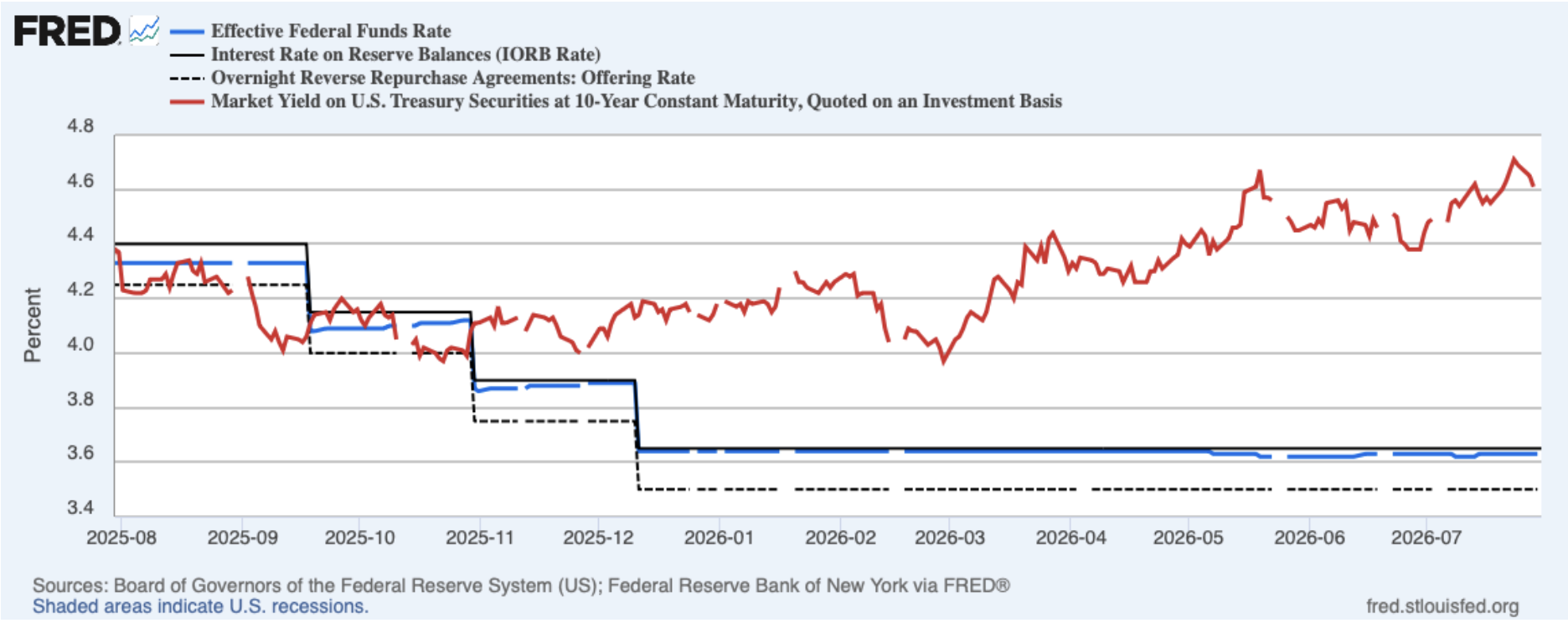
That said, as mentioned above, it remains unclear how to reconcile Trump’s stated desire of maintaining low and stable interest rates with Warsh’s actions, which point toward higher and more volatile rates. Although the FOMC left the target range for the federal funds rate unchanged at 3.50–3.75 percent (bounded by the overnight reverse repo rate and the interest rate on reserve balances [IORB], respectively), Warsh appears perfectly comfortable allowing Treasury yields to move higher as markets adjust (figure 1).
As if markets were inherently self-correcting and stable, he remarked after the meeting that “market participants are learning to play the ball, not the referee.” History, however, suggests that without rules and intervention, the game eventually breaks down and everyone ultimately loses.
Institutionally, as the monetary authority and monopoly supplier of bank reserves, the Federal Reserve cannot simply disregard the shape of the yield curve. Allowing it to steepen—or deliberately signaling indifference in order to encourage such an outcome—is simply another way of tightening financial conditions, albeit presented as the result of market forces rather than an administrative policy decision.
One question nevertheless remains. Shrinking the balance sheet affects not only the liability side of the Federal Reserve’s balance sheet but also the asset side. What does Warsh have in mind regarding the Fed’s assets? Selling them and creating downward pressure on financial asset prices in a market that is already increasingly fragile, precipitating another financial crisis? This is precisely what the Federal Reserve has been trying to avoid since the 2008 financial crisis. It would not be the first time that, in the name of “normalization,” central banks ended up becoming a source of financial instability.
The Fed does not have many good options left. Raising rates risks triggering a crisis; selling assets risks triggering one too. Low and stable rates are the only viable path left. What the Fed should be doing instead is watching the dominoes: studying household, bank, and other institutional exposure to leveraged investments in crypto and computing infrastructure, and thinking carefully about how to insulate the sound parts of the financial system before the AI bubble bursts.
Eggertsson, G.B. and Woodford, M. (2003). “The Zero Bound on Interest Rates and Optimal Monetary Policy,” Brookings Papers on Economic Activity, Economic Studies Program, The Brookings Institution, vol. 34(1), pages 139-235.
Tcherneva, P. R. (2011). “Bernanke’s paradox: can he reconcile his position on the federal budget with his recent charge to prevent deflation?” Journal of Post Keynesian Economics, 33(3), 411–434. https://doi.org/10.2753/PKE0160-3477330301.
Tymoigne, E. (2016) “Government monetary and fiscal operations: generalising the endogenous money approach”, Cambridge Journal of Economics, Volume 40, Issue 5, September, Pages 1317–1332, https://doi.org/10.1093/cje/bew012.
Tymoigne E. (2023). “The Volcker Myths” Monetary Policy Institute, https://medium.com/@monetarypolicyinstitute/the-volcker-myths-8579cea33b95.