If at First You Don’t Succeed, Try, Try Again
Will Kevin Warsh’s Fed End the AI Boom and Tip the Economy Into a Recession?
Introduction
The monetary policy tightening cycle is underway: the Federal Open Market Committee (FOMC) unanimously decided to raise rates at its September meeting and is on track to raise them again, at least once more in 2026. Federal Reserve Chair Kevin Warsh had already indicated a more hawkish stance during his Jackson Hole speech, arguing that “[p]rice stability is not self-executing, nor is inflation necessarily mean-reverting.” He further reiterated that “[i]t is the Fed’s job to deliver stable prices,” and reinforced the Fed’s commitment to the 2 percent inflation target as a “firm, fixed target.” Even voices typically dovish on monetary policy were calling for a small rate hike before the Fed meeting.
Those in favor of a hike believe that rising inflation in recent months points to a widespread problem that is becoming hard to uproot. While it’s almost never clearly explained how hiking rates by 25 or even 75 basis points will move us toward the inflation target, hike the Fed must, lest it put its credibility at stake. Yet Warsh didn’t seem to believe that questions about how monetary policy was going to tackle inflation merited an answer during his post-FOMC Q&A with reporters.
In March of 2022 we argued that raising rates was the wrong medicine for the pandemic’s inflation. We warned that high rates would do nothing to solve the supply-side problems the economy was facing. We are in a similar situation today. Much as the impact of rate hikes to fight supply chain disruptions during the pandemic were ultimately ineffective in reducing inflation (although inflation did fall as economies reopened and production began to recover—it never came down to the Fed’s self-imposed target), the Fed’s rate hikes will not reduce the inflation caused by trade wars and hot wars.
What is more likely to happen is another financial crash—if the past is any guide.
The degree to which higher interest rates might have slowed the economy has been muted by the AI buildout, which boosted both growth and the stock market. While AI-related investment has largely been unhindered, as more of it is getting financed through borrowing, higher rates potentially threaten the debt structures that have been expanding behind the scenes.
Fed Thinking Behind Rate Hikes
The Fed began one of its quickest tightening cycles in March of 2022, raising rates from the range of 0–0.25 percent to 4.25–4.50 percent by December. It continued raising rates in smaller increments after the banking turmoil of March 2023, reaching the range of 5.25–5.50 percent by July. After holding them steady for more than a year, the Fed cut rates by 50 basis points in September 2024 and cut them twice more, by 25 basis points each time, before the end of the year. Another three 25 basis point cuts occurred in 2025, lowering the rate to the 3.50–3.75 percent range where it stood before the most recent hike. Over this time, the unemployment rate increased, from 3.6 percent in March of 2022 to 4.2 percent as of September 2026. Inflation, while down from its post-pandemic peak, has stayed above the Fed’s target and has changed its trajectory upward since 2025. This turn in the trajectory of price increases, especially since January, is what ultimately led the Fed to change course toward tightening.
Still, the case for rate hikes rests not so much on the belief that higher rates will solve inflation stemming from tariffs or the war against Iran per se. Rather, the Fed (and many outside the Fed who support the hikes) believes it cannot be seen as doing nothing in the environment of continued inflation. So, it must do something. Thus, tightening monetary policy is necessary to signal the Fed’s commitment to its inflation target—to protect its credibility. After all, the groupthink that now guides policy is the belief that the Fed controls inflation by convincing market groupthink that it is controlling inflation by controlling groupthink.
Since at least the 1990s up to the COVID pandemic-driven supply chain disruption, inflation remained relatively low and stable, as Figure 1 shows. Over that period, however, the Fed remained quite active, raising rates sharply to fight inflation that had not yet made an appearance to demonstrate to markets that it was serious about its inflation target. This preemptive monetary policy has allowed the Fed to claim—even if improbably—that the proof of its virility was in the pudding of low inflation. A hyperactive Fed facing low and steady inflation is a hyper-successful Fed.
But if inflation is not a good predictor of Fed rate hikes, what is? The evidence favors the view that it is falling unemployment that triggers a tightening cycle (as shown in Figure 1 below). This is based on the notion of a trade-off of unemployment and inflation: if unemployment gets too low, inflation pressures arise. Yet, no one at the Fed wants to admit that monetary policy aims to keep people unemployed—best to be seen as an inflation-fighter, not a jobs-fighter.
Figure 1
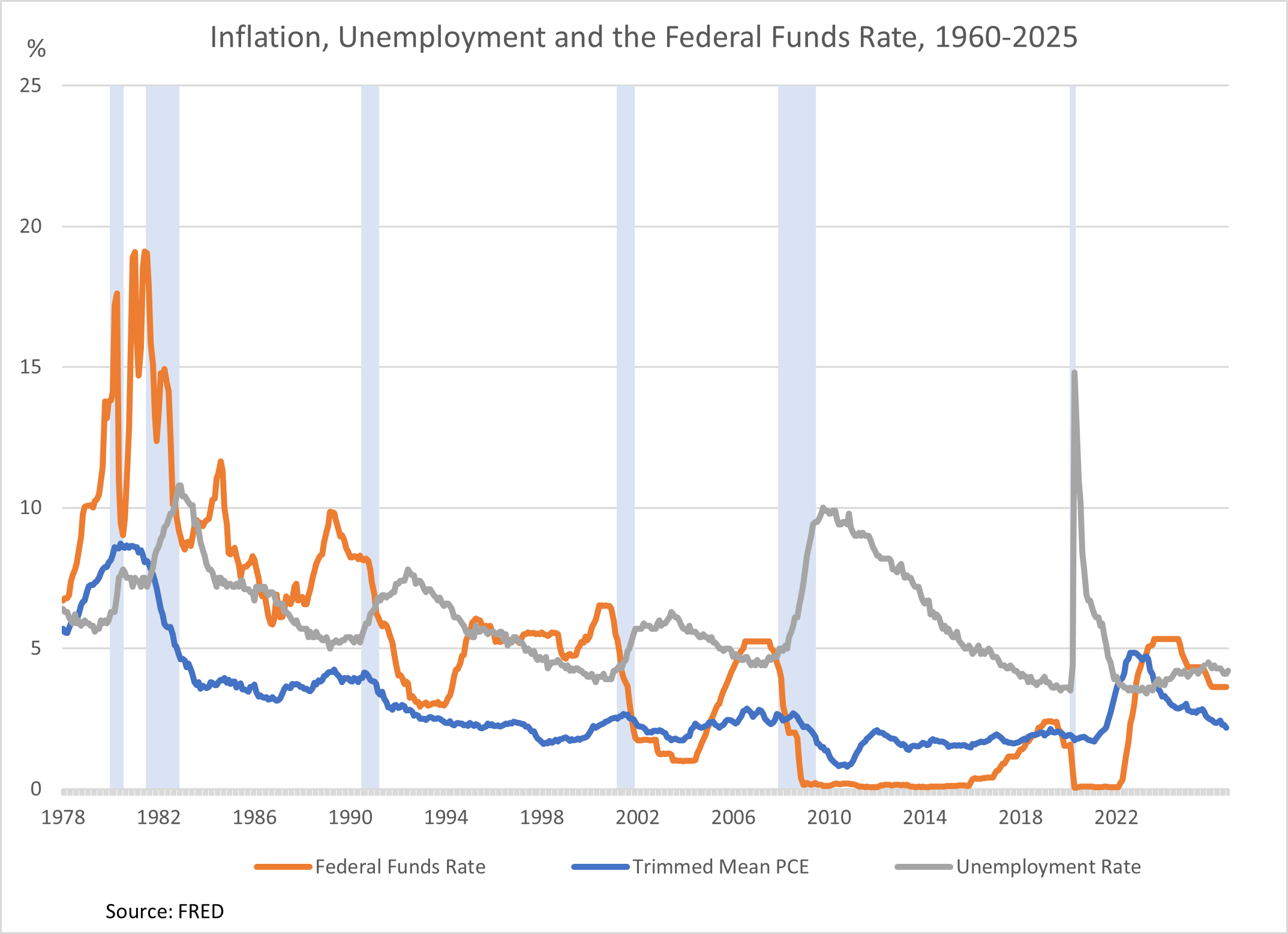
The situation in recent months is quite different in that the rate hikes are not preemptive. Inflation has remained stubbornly above the Fed’s target and unemployment has been coming in steadily at a little over 4 percent—an unemployment rate that conventional economists find acceptable. But even as unemployment remains low, labor markets are weaker today than they were when the Fed began its tightening cycle in 2022—as measured by openings as well as turnover (low hiring, low firing). Yet, despite the President’s desire for lower rates, it was inevitable that the Fed would begin a cycle of rate hikes. The Fed was put in the unusual position of raising rates to fight actual inflation—rather than to reverse a falling unemployment rate.
That is easier said than done.
What Has Been Driving Inflation?
The discussions around Fed policy rarely take into account the drivers of inflation. We will highlight three main drivers: energy, tariffs, and housing. First, we turn to energy and especially the disruption of petroleum markets.
As Figure 2 shows, energy has become the biggest driver of inflation—with most of the increased inflation since March 2026 attributed to it.
Figure 2
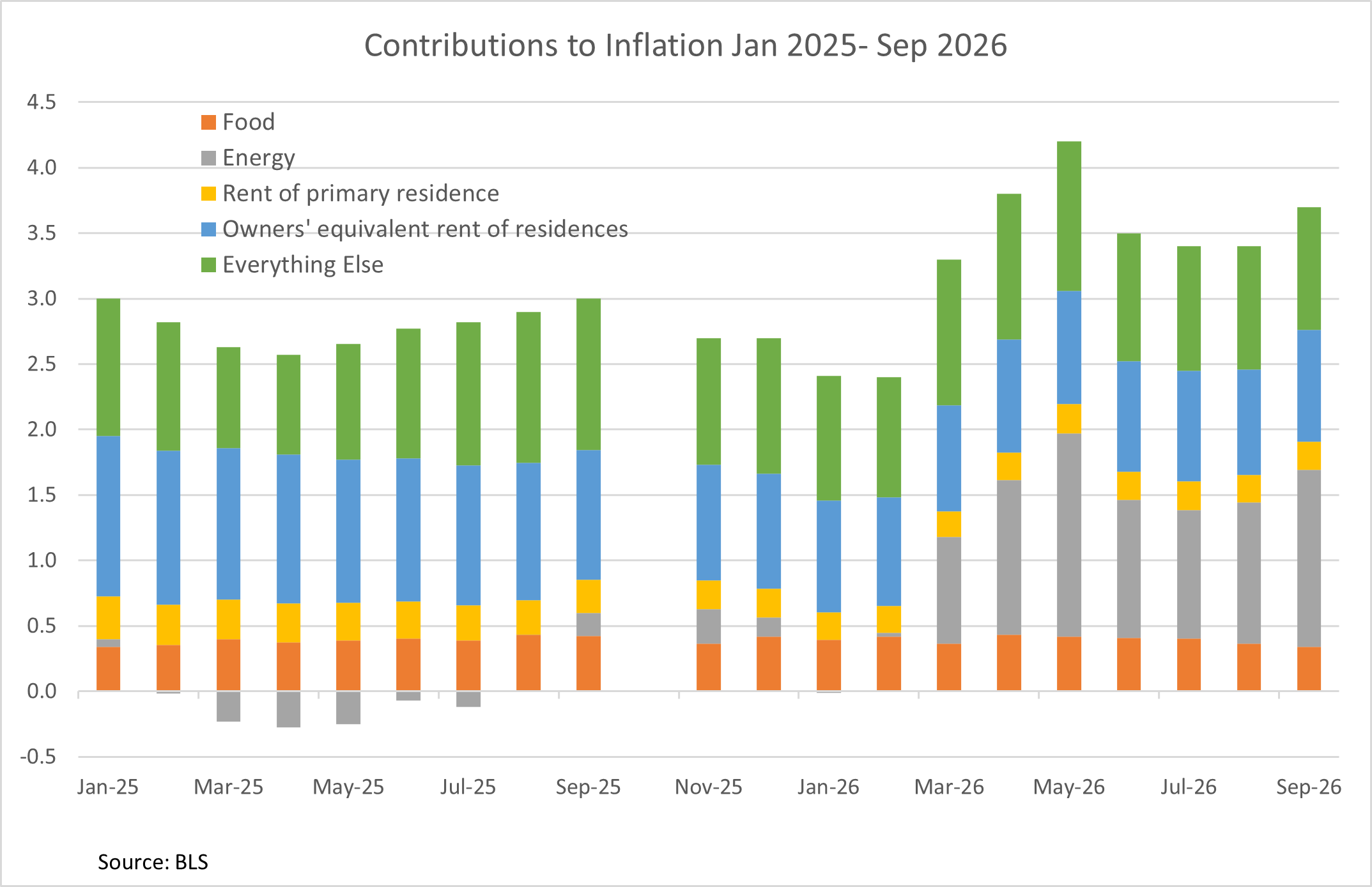
But this graph reports only the direct contribution of price increases in chosen sectors to an inflation index, which can understate the importance of critical inputs to production of output for consumption. For example, it takes a lot of petroleum products to produce and transport food as well as other consumer goods and services (i.e., air transportation). Obviously, when oil prices rise, costs increase for all sectors in which transportation is important—whether in the service sector or the goods sector. For example, direct costs in the airline transportation sector would include the fuel and other petroleum products (such as lubrication oil) required, plus the indirect transportation costs of delivering meals for flights and the higher costs of producing the food served (both direct costs of running the tractors and the costs of fertilizers derived from petroleum). Higher costs of shipping by air then feed through to other sectors.
In a recent Levy Institute working paper, Samuel Stockman has calculated the direct and indirect impact of an energy price shock (impacting coal and petroleum) across sectors of the US economy (see Figure 3, which replicates Figure 9 in Stockman’s paper). This graphically emphasizes the modern economy’s reliance on petroleum and coal—with large direct and indirect effects on many other sectors, some obvious and others less so. It is thus no surprise that oil price shocks in the early and late 1970s led to two of America’s highest inflation periods. In both cases, it took a long time for the impact of the shock to run its course through impacted sectors. President Trump’s war of choice against Iran will not prove to be an exception—no matter what the Fed does. The disruption of petroleum markets will have long legs so far as entrenched inflation pressures go.
Figure 3 Price Shock to Petroleum and Coal Products
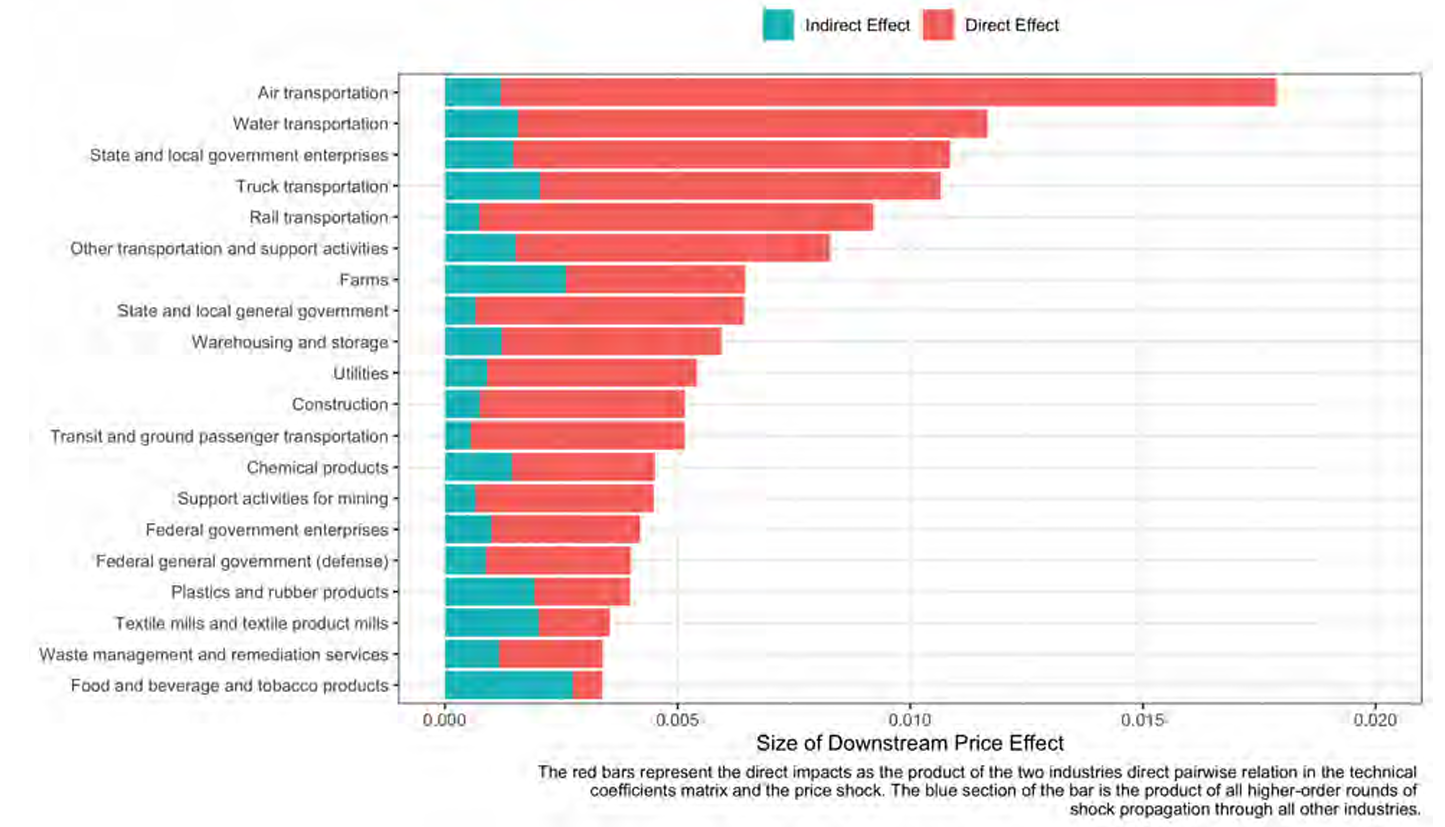
Source: Stockman 2026
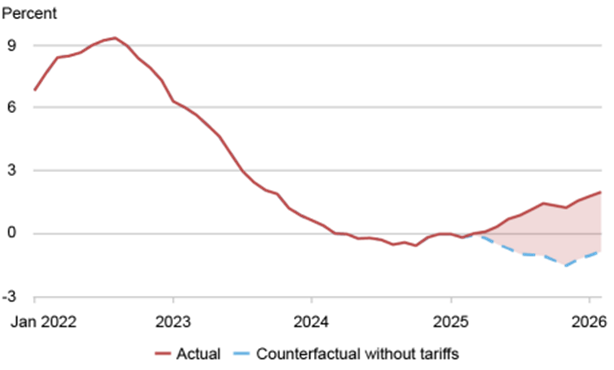
Second, Trump’s tariffs have played a significant role in maintaining inflation above the Fed’s target. A recent estimate by the NY Fed on the measured rate of inflation of non-oil consumer goods shows the contribution of the latter to measured inflation would be negative since 2025 (that is, would reduce the overall rate of inflation) rather than contributing to higher inflation in the absence of tariffs.[1]
Figure 4 Measured Rate of Inflation of Non-Oil Consumer Goods
Source: Federal Reserve Bank of New York
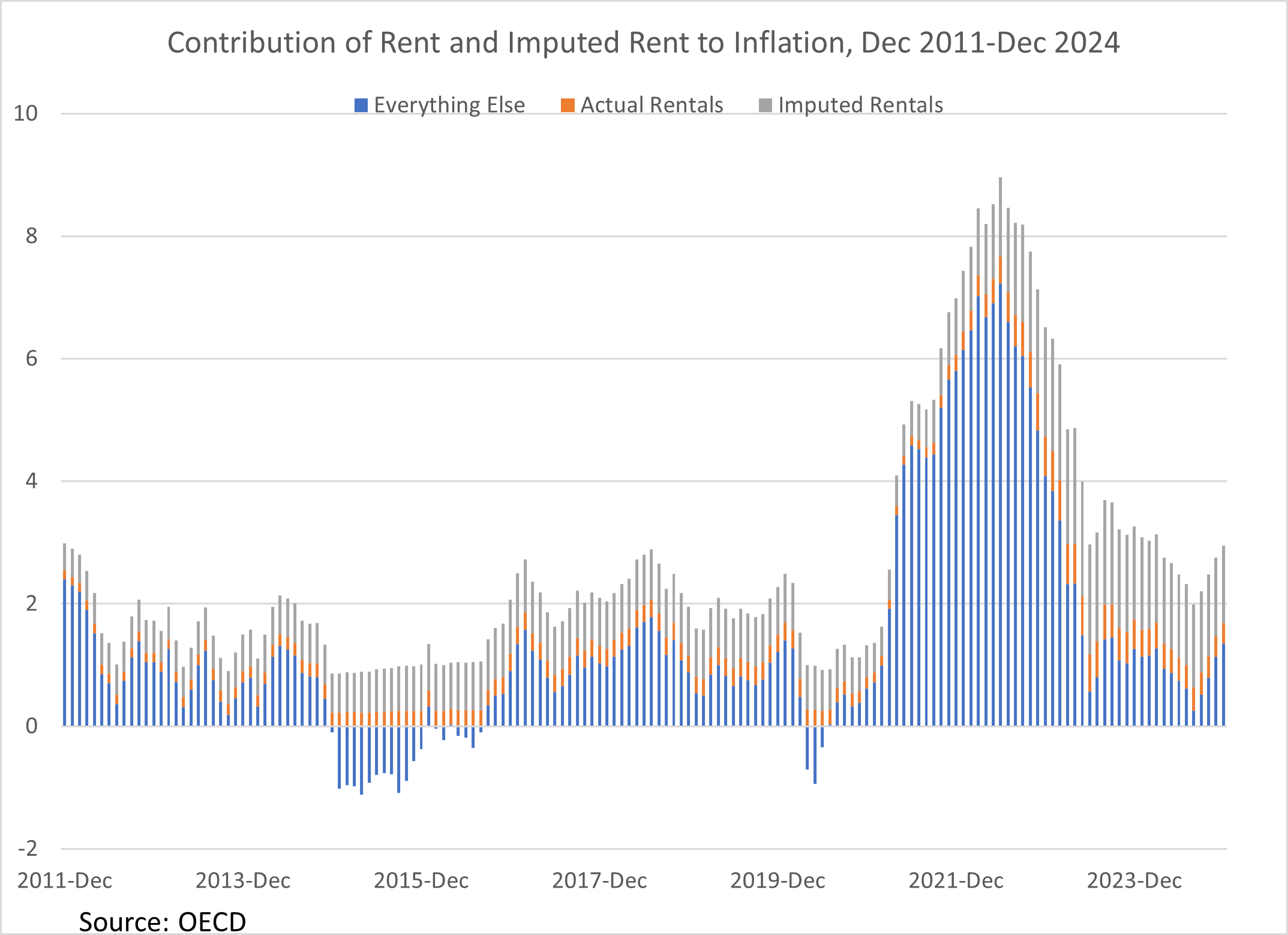
Lastly, looking at Figure 5, it is clear that the majority of measured inflation in the US economy comes from housing, with Owner’s Equivalent Rent (OER) typically playing the biggest role. This is imputed rent that homeowners might have paid if they had instead rented an equivalent home (See Papadimitriou and Wray 1994 for discussion of OER). Starting in March of 2023, the combination of Actual Rent and Owner’s Equivalent Rent was at least half, and in many months, contributed more than half of measured inflation.
Figure 5
A main cause of rising shelter costs is a severe shortage of affordable housing, in part a legacy of the large reduction in the pace of construction of new housing following the Global Financial Crisis, plus rising rents due in part to private equity’s purchases of houses and use of monopoly power to raise rents. Higher interest rates will clearly exacerbate the needed buildout of more housing. Each percentage point increase in interest rates raises a mortgage payment by 10–13 percent. Add higher interest rates, and you have compounded the affordability crisis.
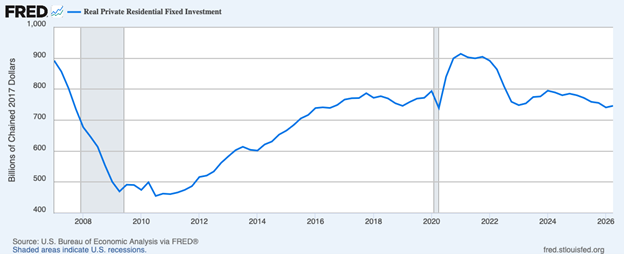
As Figure 6 shows, residential investment, the most interest-sensitive component of investment, has stalled since the Fed began its tightening cycle. Residential investment experienced a significant jump during the pandemic but has since fallen to its 2016–17 levels. According to US Census Bureau data, total US housing starts declined by approximately 15 percent, from 1.60 million units in 2021 to 1.36 million in 2025.
Figure 6
Not only is there a lack of new construction, but the rate hikes have also locked homeowners in place. The usual transition from cheaper, smaller, starter homes to the newer American “dream homes” in the suburbs cannot take place because owners are unwilling to give up their old 3 percent mortgages for new unaffordable 7 percent mortgages. That also means that younger households cannot move from rental units into starter homes, keeping rental units scarce and expensive—driving up the rental component of the inflation index. It also impacts the labor markets because workers are geographically stuck—explaining part of the reason why turnover in labor markets is low. Fed rate hikes only make all of this worse.
Finally, higher interest rates work through the cost channel. It is often forgotten that producers of goods and services issue both short-term and long-term debt that must be serviced. The prices they charge must cover interest costs, rents, and commercial mortgages. Just as households (and governments) must pay interest, so does business—and higher interest rates mean higher costs to be covered by raising prices, or taking lower profits.
In sum, we know what’s driving inflation: it’s the housing shortage, Trump’s high tariffs, and the war of choice against Iran. And even the proponents of Fed rate hikes admit that the Fed cannot do anything about any of these (if anything, rate hikes worsen inflation pressure arising from these sources). There is, therefore, a disconnect between what is driving inflation and the tools we are using to fight it. Higher interest rates will do nothing to fight a tariff-induced price increase or make up for the conflagration in the Strait of Hormuz.
Today, as in 2022, raising rates is the wrong medicine. The usual pronouncements are being made about expectations getting out of hand and the importance of signaling to workers and firms that the Fed is committed to controlling inflation. But it is hard to imagine that when workers are negotiating for wages, they pay particular attention to the Fed’s inflation fighting credibility; most workers are not professional economists after all! Similarly, if Fed actions/credibility could discipline corporate price setting, we would not have experienced the kind of seller’s inflation we experienced in 2021–23. No amount of Fed assurance that it is fighting inflation can make up for the obvious impacts of tariffs, war, and a housing shortage on living costs.
Trying to solve inflation, a sectoral problem, through an aggregate tool, such as higher interest rates, ignores the root causes of inflation, and threatens to finish the job by throwing the economy into a recession or even worse, another serious financial crisis. At best, the small rate hikes will be a non-event. At worst, the Fed will follow its usual path, continuing with ever more aggressive hikes come next year. Just as Alan Greenspan’s hikes finally popped the dot.com bubble and more rate hikes crashed the housing bubble, the rate hikes may be the nail in the coffin of the AI boom.
Could Higher Rates End the AI Boom?
The scale of AI capex investment and its impact on US GDP growth has garnered considerable attention. The AI spending has continued apace despite restrictively high interest rates. Indeed, its beginning coincided with the most restrictive monetary policy in more than a decade as the Fed hiked rates above 5 percent over a short period of time after the COVID recession. In fact, the high interest rates may have acted as a boost to the so-called AI hyper-scalers—companies such as Google, Amazon, and Apple—that were flush with cash and could therefore earn high rates due to the restrictive monetary policy. In a speculative bubble driven by creative finance (much of it of a circular nature), raising finance costs a few hundred basis points is not going to kill the speculation, even as it does impact the rest of the economy. Indeed, while the AI investment boom has recently proceeded unhindered, other types of investment have not: investment excluding tech has taken a significant drop.
Since the release of ChatGPT, tech investment has gone from a small contributor to economic growth to comprise almost half of it in 2026. While not all tech investment is AI related, it is highly plausible that most of it is, due to the scale of the AI buildout. Furthermore, investment in capital assets has not been the only avenue through which AI has impacted the economy. The roaring stock market boom driven by tech has also boosted the wealth of the richest Americans, fueling their consumption. While the marginal propensity to consume out of high wealth is typically low, the enormous increase in wealth at the top since 2022 implies a significant injection into personal consumption expenditures (estimated at 1 percent of GDP each year).
The unspectacular average GDP growth rate in the range of 2.3–2.5 percent since 2022 means that in the absence of the AI buildout, the economy’s growth would be stagnant. If inflation remains elevated, while the tech investments pull back, we could have stagflation—the worst of both worlds—like the 1970s all over again.
But as AI capex is exceeding even the hyperscalers’ ability to finance out of cash flows, it is moving into the financial engineering stage. Even if the AI boom itself is not sensitive to interest rates, the financial structure that is being created in the shadows will be sensitive to rate hikes. We are starting to see troubles in AI finance, particularly in the rising price of credit default swaps—used as insurance against downside risks.
Déjà Vu Again?
While many commentators have emphasized parallels between the AI boom and the dot.com bubble, there are important monetary policy parallels that have not been discussed. The 1990s monetary policy bears some resemblance to what the Fed has been doing since 2021.
Over the course of the 1990s, the Fed was on a tightening cycle, raising rates from 3 percent to 6 percent between 1994 and 1995. The first domino to fall from tighter policy was Mexico, with its so-called tequila crisis (Mexico had borrowed in dollars from US banks—rising rates and a rising dollar made it difficult or impossible to service that debt—which then created a potential crisis for the biggest US banks holding those Mexican debts). Then the Asian Tigers followed suit during the 1997–98 Asian Financial Crisis (similarly, they were impacted by the rising dollar because they were pegged to the dollar and their exports became too expensive, so their dollar reserve earnings fell to the point that markets bet they could not maintain the pegs). While that crisis cannot be blamed solely on the Fed, the higher rates led to the unwinding of carry trade positions and, in the environment of pegged exchange rates, led to a financial crisis.
Greenspan’s Fed quickly lowered the rates following the collapse of Long-Term Capital Management in 1998. However, the Fed soon reversed course, hiking rates once again from 4.75 to 6.50 percent from May 1999 to June 2000. While the dot.com boom was unsustainable and would clearly have come to an end eventually, the high rates sped up the process. And importantly, it didn’t take a dramatic rate hike; even a hike of 2 percentage points did the job, bursting the bubble.
The Fed again lowered rates in response to that bust—to 1 percent. That goosed the housing bubble (that was already well underway), fueling runaway fraudulent mortgage lending and securitization. The Fed, again, burst that bubble by raising rates to 5.25 percent—bringing on the Global Financial Crisis that created one of the worst recessions in US history. Indeed, it could be argued that in some ways the US economy still has not fully recovered for a large proportion of the population.
In some ways, our current episode is most similar to what happened in the 1990s. On one hand we have the AI boom and the physical infrastructure buildout, that is, the bubble’s scope is largely limited to one sector: tech. However, we also have the financial fragility that has been building up in private credit markets, as well as a stock market bubble largely confined to tech-related stocks. Unlike the situation in the mid-2000s, we do not have a housing bubble, although we have a housing affordability crisis.
Marginally higher short-term rates may not push us to the point of “selling out positions to make positions” (Minsky’s phrase—liquidating assets to service debt), causing an “asset price deflation.” However, long-term rates have been especially affected by Fed actions, not necessarily because of the small rate hike, but due to the strong likelihood that another tightening cycle is afoot. Corporate borrowing rates are already a percentage point higher compared to 2025. Indeed, they are now higher than at the peak of the Fed’s tightening cycle in 2024.
The conventional wisdom used to be that it takes as much as a 400-basis point move to reduce demand for credit enough to significantly reduce spending. The Deutsche Bank Research Institute recently confirmed that perspective when it looked back at the Fed’s previous 14 rate hikes over the past 70 years and found that “they have lasted 22 months on average (15 months median) and delivered an average of 478bps of tightening (313bps median). One recurring feature of Fed tightening cycles is that their eventual magnitude is rarely apparent at lift-off.” They also found that markets and pundits almost always underestimate how long the tightening cycle will go on, and how high rates will go. Typically, the tightening cycle ends only when a recession hits: on average since 1980, a recession follows within three years of the first rate hike, with a range of 11 to 86 months.
The AI bubble is orders of magnitude bigger than the dot.com bubble, and much bigger than even the early 2000s housing bubble. We have argued that a better comparison is to the stock market bubble that crashed in 1929—both in terms of the shaky finances as well as the size of the bubble relative to the economy. That crash led to the Great Depression. While it is true that both the Fed and the Treasury are far better equipped and prepared to intervene than they were in 1929, the prospect of another great crash is worrying.
Conclusion
At first glance it seems like the Fed got it right back in 2022 when it abandoned the view that the COVID inflation was transitory and began to hike rates. The coveted “soft landing” appeared to have been achieved without recession while the unemployment rate went up only slightly. A closer look at the economy, however, shows that if not for the AI boom (which the Fed could neither foresee nor take into account when it began its tightening cycle in 2022), the economy would have likely been in stagnation over the entire post-Covid era—up to the present—if not in an outright recession. And while inflation has come down, that is clearly not due to higher interest rates, but due to the normalization of the supply chains disrupted during COVID. Furthermore, despite relatively restrictive interest rates, the Fed has not been able to bring inflation down to its official target of 2 percent.
But as the Fed is embarking on additional tightening, the economy is in a different place compared to March 2022. The buffer of savings American consumers had accrued from the pandemic’s stimulus checks is long gone. The positive fiscal headwinds from the Bipartisan Infrastructure Law, the CHIPS and Science Act, and the Inflation Reduction Act are no longer in play. The labor market today is significantly weaker, with a higher unemployment rate and a lower job vacancy rate. Much of the population is dealing with a severe affordability crisis. Moreover, too much of our economy rests on the success of just one sector—AI. And that sector is now facing growing headwinds and questions about its ability to generate real revenue.
As the Fed is changing course, it risks popping that AI bubble. We do live in interesting times.
[1] To be clear, the high oil prices can affect prices of non-oil consumer goods, as discussed above.