

Treasury Buybacks: Much Ado About Nothing?
How Central Bank Policy, Not Bond Markets, Sets Government Borrowing Costs
Introduction
The recent move by the US Treasury to increase the buybacks of long-term Treasury bonds has created an equal mix of confusion, uncertainty, skepticism, and even panic. Some have argued that the Treasury is stepping on the Fed’s toes by engaging in monetary policy that is the Fed’s domain. Others maintain that the Treasury’s actions are not going to solve the problem since high interest rates merely reflect the market’s “correct” view that the US government has accumulated more debt than is sustainable. Yet, others have noted that the implementation itself seems confused, as it’s not clear why the Treasury is doing what it’s doing and why it’s taking action now. Instead of providing a clear answer, Treasury Secretary Scott Bessent floated the idea of using Treasury’s General Account at the Fed to fund increased buybacks of up to $1 trillion.
While Bessent has tried to sell this as a routine intervention—pointing to a similar action taken by Janet Yellen in 2024 when she headed the Treasury (for which he criticized her at the time; Klein 2026)—markets are not convinced. He claimed the buybacks are designed to enhance the liquidity of bond markets, not to impact bond prices and, thus, interest rates. But many commentators see this as an attempt to lower interest rates to please President Trump, whose pick to head the Fed, Kevin Warsh, is unwilling or unable to loosen monetary policy1. Not only are those high rates potentially creating headwinds for economic growth—and for the equities market boom—they are also increasing government payment of interest on the debt and thereby increasing the federal government’s deficit and growth of the debt ratio.
In this note we argue that the current high interest rates on Treasury debt are not reflecting the market’s belief that the US debt has reached unsustainable levels, but are due to the Fed maintaining higher interest rates for longer than was expected. Treasury’s interest payments have gone from a little over $500 billion in 2020 to more than $1.2 trillion in the second quarter of 2026, not because the market is penalizing the US government, but because of Fed policy (just as the Fed’s zero interest rate policy —ZIRP—drove the low interest rates following the Global Financial Crisis [GFC]). If the Treasury only issued short-term bills, which closely track the Fed’s interest rate target, this would be as clear as day. But since it also issues longer-term bonds, and since the 1970s it has allowed the rates on these to be determined at Treasury auctions, it has created the wrong impression that markets dictate the government’s borrowing costs (and can, by extension, force the government to change policy course).
Further, we do not see strong evidence that the market needs more liquidity, nor that the buybacks have been undertaken for that purpose. Thus, Treasury’s actions are more correctly viewed as a desperate response to the Fed’s policies—they are bound to fail because the Treasury only has the equivalent of a peashooter, while the Fed has the big bazooka when it comes to setting rates. The market knows that, and that is why rates have risen after the Treasury’s intervention.
Treasury Buybacks: All Hype, Little Substance
The US Treasury announced on August 19, 2026 that it was planning to at least double the buybacks of long-term US Treasury securities, from $2 billion to $4 billion. The Treasury would use its “cash” (deposits of tax revenue at the Fed) and issue short-term bills to buy back the long-term bonds purportedly to rectify deteriorating liquidity conditions on the long end of Treasury debt. That would allow markets to use the liquidity created to buy new issues. The market reaction was initially strong but short-lived. Pundits have overwhelmingly viewed the move as a misguided attempt by the Treasury to lower rates at the long end of the bond market.
However, Bessent (as well as a few market participants) insisted this was to resolve liquidity problems, much as the Treasury has used buybacks before. For example, back in 2000, a problem was created (maybe surprisingly!) by President Clinton’s budget surpluses that were flooding the Treasury’s deposit account at the Fed. Normally, the Treasury uses this account much as households use their bank deposits: as a temporary storage of spending power. If the budget is near-to-balance, the flows into the account match the flows out (revenues increase deposits, spending decreases them). But budget surpluses meant that the private sector was spending more on taxes than the government was putting into the economy and, by extension, that the balance in the Treasury’s account was growing. The budget surplus was thus reducing bank liquidity by reducing bank reserves (when taxes are paid, the taxpayer’s deposit is debited by the bank, the bank’s reserves at the Fed are debited, while the Treasury’s account at the Fed is credited). So, the Treasury began buybacks, reducing its deposits at the Fed and increasing bank reserves at the Fed by the same amount. These buybacks restored bank liquidity.
More recently, in May 2024, Treasury Secretary Yellen used buybacks of older, lower coupon bonds that had been issued during the extremely low interest rate period that followed the GFC. These “off-the-run” securities were illiquid and difficult for holders to sell/borrow against, so with the Treasury standing by to purchase them, investors and dealer banks could get cash to purchase new issues. In other words, this could be seen as a strategy to protect the Treasury’s new issue market—ensuring sufficient liquidity so that Treasury could sell new, “on-the-run” bonds to replenish its account at the Fed. This situation was quite different from that of 2000 as the budget deficit was large and chronic—and avoiding disruption in the bond market was important (Whalen 2026).
Bessent has argued that the situation today is similar to that of Yellen’s predicament and has pointed to a “low” bid-to-offer ratio of 2.58, versus an average of 2.62 over the past six months. However, unlike Yellen’s buybacks, which were designed to be “maturity neutral,” Bessent’s buybacks are largely focused on long maturities—where interest rates have been rising—and issuing bills and bonds on the short end2. That looks like an attempt to reduce pressure on long-term interest rates—that is, like monetary policy, not a policy designed to provide liquidity to smooth the functioning of markets (see Whalen 2026).
But if Treasury’s actions are indeed an attempt to lower its borrowing costs by doing QE/stealth monetary policy, then what does that imply about who really determines the government’s borrowing costs?
Are Markets Punishing the US Government for Its Profligacy?
Some see this episode as the beginning of the unraveling of the US Treasury market. Treasury’s actions are dismissed as “financial engineering” that cannot really address the core issue, which is the “unsustainable” level of US government debt. Indeed, mainstream economics predicts that rising government debt will lead to higher interest rates as government competes for the limited amount of private savings, thus crowding out private investment. According to this view, interest rates (like all market prices) are determined by supply and demand, where saving provides the supply of loanable funds and investment creates a demand for them. A rising interest rate, then, is evidence that demand for loans has exceeded the supply.
This is the theory that is now supposedly validated in real time as the debt chickens have finally come home to roost. While increasing taxes can be one solution, most fiscal hawks are largely focused on spending cuts, especially reductions to so-called entitlements. According to this view, the problem can only be resolved through fiscal consolidation, i.e., fiscal austerity. But rather than reining in its spending, the government is now trying to hijack the market’s power to set interest rates through Treasury buybacks. This is claimed to be the long-awaited “financial repression” that was always around the corner—governments repressing financial markets to lower the cost of their own debt, since, supposedly, they are running out of options for servicing/paying it back. The financial repression view, therefore, assumes that markets do, and should, determine the interest rate on government debt.
However, there has long been a disconnect between this “loanable funds” theory and reality. For instance, the theory could not offer a good explanation for why interest rates over the past three decades were falling even as the US debt-to-GDP ratio kept climbing, as shown in Figure 1. Furthermore, this theory ignores the simple accounting reality: government debt issuance is more-or-less on pace with government spending (including its spending on interest) in excess of tax revenue—meaning the “saving” that its bonds are supposedly soaking up is round-tripping back into the economy through the government’s deficit. Indeed, by identity, the deficit of the government must be met by a surplus in the nongovernment sector. The loanable funds model mistakenly assumes that the pool of savings is fixed, while accounting shows that the government’s deficit creates private income that can be saved.
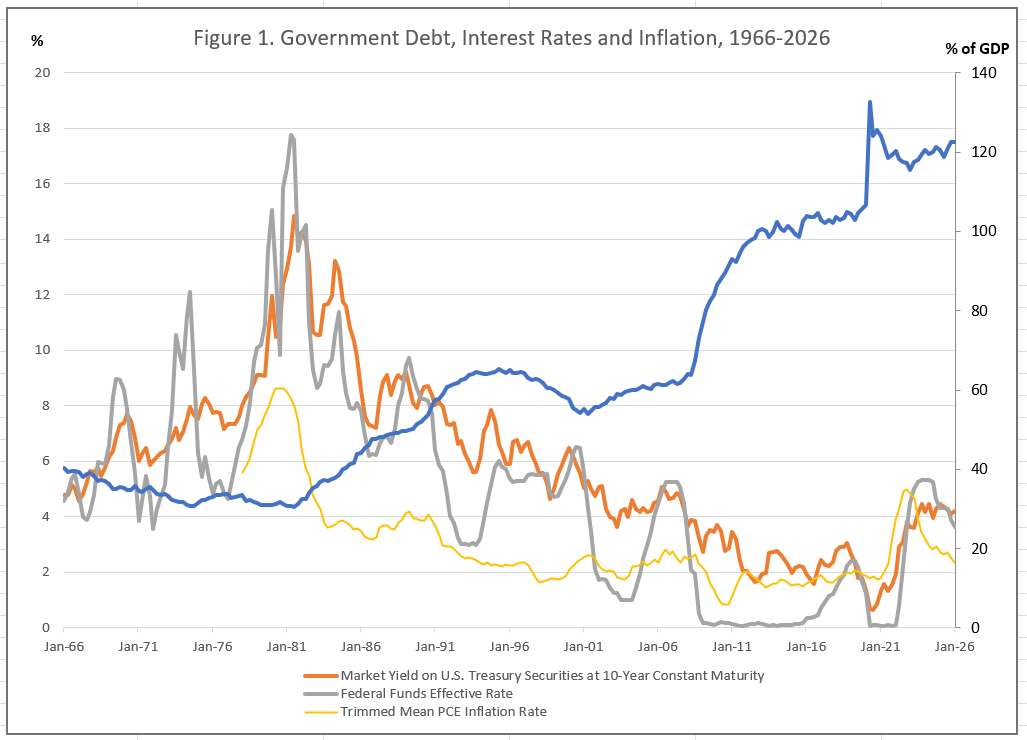
More importantly, as Figure 1 shows, the yield on 10-year Treasury bonds is not correlated with the debt-to-GDP ratio, but it closely tracks the Fed’s policy target—the fed funds rate. The low interest rate period that commenced during the GFC also coincided with the largest “peacetime” increase in US government debt. It was Fed policy to keep rates near zero. Bond yields went up after COVID, not because of the rising debt-to-GDP ratio, but because the Fed changed policy course and started raising interest rates to fight inflation.
This is perhaps the biggest misconception that the current situation may put to rest: the interest rate is a policy variable, not something determined by financial markets. In modern times, we have delegated that particular responsibility to the central bank, the Fed, which everyone understands sets the short-term interest rate.
There is a bit of a Jekyll versus Hyde aspect to orthodox thinking about interest rate determination. Until the early 1990s, the Fed did not announce interest rate targets and actively sought to avoid taking the credit, or blame, depending on how one looks at it. When Paul Volcker took over as chairman in 1979, he announced targets for the money supply that would be hit by manipulating nonborrowed reserves. It is likely that the Fed never really pursued those money targets—and it never hit them—but instead wanted to avoid taking the blame for jacking the federal funds rate to approximately 20 percent in its attempt to slay the inflation monster (Stein 2024).
However, after Chairman Alan Greenspan took a shellacking from Representative Henry Gonzalez for evasive testimony, he rounded up the FOMC members and developed a strategy of transparency and a clear policy of targeting the fed funds rate to meet the dual mandate (low inflation and moderate unemployment; Auerbach 2009). However, for that to work, the Fed must somehow possess a lever to control market interest rates (and market rates must be reliably linked to unemployment and inflation!). Let’s examine the links.
Monetary Policy versus “the Market”: Who Sets the Government’s Borrowing Costs?
Both theory and evidence show a close link between the fed funds rate that is directly controlled by the Fed and the interest rate on Treasury bills. Longer rates are more complexly determined, but even according to mainstream economics, they are composed of two parts: the average of expected short-term rates plus a term premium. As our graph above shows, there is a strong link between changes to the policy rate and movement of the 10-year bond rate.
The term premium depends on a number of factors, including duration risk—capital losses suffered if rates rise. Since the Fed typically fights inflation by raising rates, the expectation of inflation increases the perception of capital losses on long-term bonds3. There is also credit risk for all non-sovereign debt, so the interest rate must cover expected losses to default (but this risk is nonexistent for a sovereign government such as the United States government that issues debt in its own currency). In addition, there are preferences for different maturities (life insurers prefer longer-term positions, while hedge-fund speculators prefer shorter). Thus, the supplies and demands differ across the term structure and mismatches can occur in particular “habitats.”
The most commonly used model for decomposing changes in long-term interest rates into changes in the term premia versus expectations of short-term rates is the New York Fed’s Adrian, Crump, and Moench (ACM) model depicted in Figure 2. As shown, the risk-neutral rate, i.e., the “expected short-rate” portion of long-term rates, closely follows the Fed’s policy trajectory. The term premium is generally less volatile, and while it has gone up compared to the pandemic lows, it’s still not high by historical standards. Looking at 2026, the model’s estimate for the Risk Neutral Yield has gone up by 40–50 basis points in 2026, which implies that the 10-year rate is going up not because investors are demanding higher term premia for holding long-term bonds, but mostly because they expect short-term interest rates to be higher for longer (Argent Financial Group 2026).
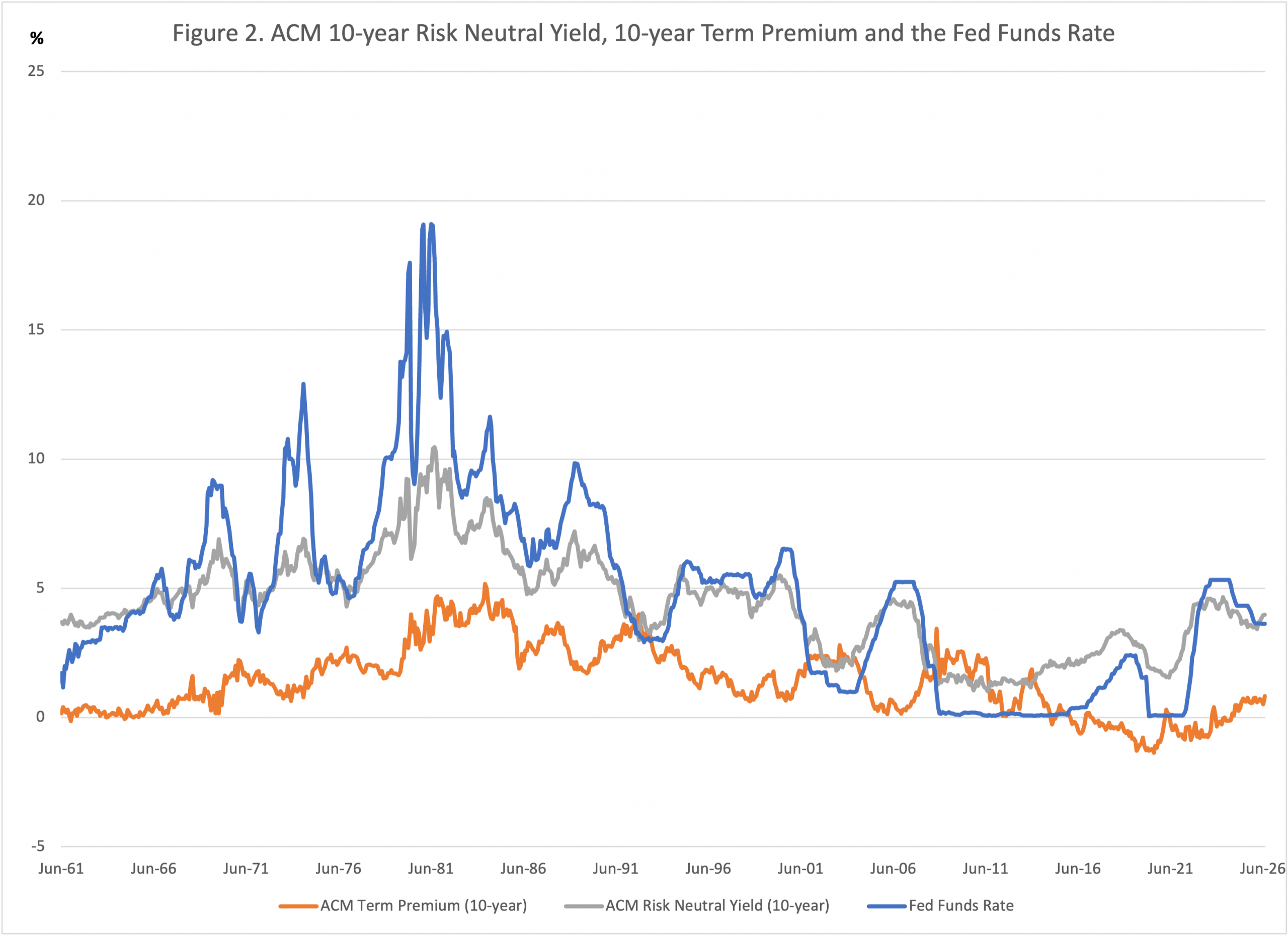
As inflation has remained above the 2 percent that central banks have adopted as their goal, the Fed’s loosening stopped—and many FOMC members have voted to reverse course. Markets have come to accept the strong likelihood that rates will soon rise. Chairman Warsh’s recent speech at Jackson Hole has reinforced that expectation.
To sum up: nominal long-term rates are complexly determined by the policy rate, expected inflation, supply and demand, and risk of capital loss. Thus, long-term Treasury yields are usually above the Fed’s policy rate (and there is also a lower limit to their yield—generally about 2 percent, because the expected capital losses exceed the return from coupons, although that barrier was briefly breached during the COVID recession). Given all that, the central bank’s control at the longer end of the maturities is not as strong as it is for the short end of the curve under the normal monetary policy regime.
However, the central bank could exercise a greater degree of control over the whole spectrum of interest rates by choosing to buy and sell at different maturities (which is what Quantitative Easing was really about, despite its name—and what the Fed did during WWII to hold bond rates down).
Conclusion
While Secretary Bessent’s buybacks may have been misguided (and even bungled), concerns over “financial repression” misunderstand the role of the government in its monetary system. The government is not like a regular borrower that must pay what the market charges. Since the 1970s, it has used the private market to place its bonds through Treasury auctions. But this does not really mean that markets determine rates on government bonds. Rather, the power to set interest rates largely resides with the Fed, as granted to it by Congress. Although the Fed only directly controls the short-term rates, it can also exercise a lot of influence over long-term rates.
Moreover, to the extent that long-term rates depend heavily on the expectations of short-term rates, the market is not really deciding the long-term interest rate but is rather trying to discover what the appropriate rate should be given the future path of the Fed’s policy rate. Bond markets are only trying to protect themselves from future Fed actions—they are not punishing government for its deficit. They want and even need government bonds.
While the Treasury can push its borrowing costs down to the overnight rate set by the Fed, by, for example, only issuing short-term bills, it cannot push rates below the Fed’s target. Thus, the Treasury’s choice of maturities should be perceived as a response to the Fed’s policy of maintaining rates higher for longer rather than a reaction to the market, since it’s ultimately the Fed that determines interest rates. The Treasury may also be legitimately concerned with liquidity in auction markets, but it is not clear that there was any need for Secretary Bessent to engage in buybacks at this time.
1 Indeed, his latest speech at Jackson Hole was hawkish on inflation, suggesting a bias toward higher rates in the near future (see New York Times 2026).
2 Yellen’s Treasury did, however, engage in maturity management as well, following the “Treasury Tantrum” in 2023, by issuing more short-term securities and slowing the issuance of long-term bonds.
3 It is often claimed that bond holders demand compensation for potential inflation because it would reduce the purchasing power represented by the savings tied up in the long-term bond—an unlikely proposition based on the view that investments in bonds represent postponed consumption. To the degree that expected inflation matters to bond holders, it is because of the likely response of central bankers.
References
Argent Financial Group. 2026. “Rate Watch – August 2026.” August 25, 2026. https://argentfinancial.com/argent-insights/rate-watch-august-2026/.
Auerbach, Robert D. 2009. Deception and Abuse at the Fed: Henry B. Gonzalez Battles Alan Greenspan’s Bank. Austin: University of Texas Press.
Klein, Ezra. 2026. “The Ezra Klein Show,” featuring Robin Wigglesworth. Podcast audio. New York Times, August 28, 2026. https://www.nytimes.com/2026/08/28/opinion/ezra-klein-podcast-robin-wigglesworth.html.
New York Times. 2026. “Kevin Warsh Signals Hawkish Stance on Inflation in Jackson Hole Speech.” August 28, 2026. https://www.nytimes.com/2026/08/28/business/fed-kevin-warsh-speech-inflation.html.
Stein, David. 2024. “The Politics of Apolitical Money: Paul Volcker and Monetary Policy in Action.” In The Elgar Companion to Modern Money Theory, edited by Yeva Nersisyan and L. Randall Wray, 352–63. Cheltenham, UK: Edward Elgar Publishing.
Whalen, R. Christopher. 2026. “Trump: Budget Deficits & Credibility.” The Institutional Risk Analyst, August 23, 2026. https://theinstitutionalriskanalyst.com/so/tr/a002270b-9345-4205-88e3-67a23160d47e?cid=9a4f8f2d-aead-433b-8003-6569830c9fba.